
Chapter 9: Rules and Recursion
While simple Datalog queries are useful for finding patterns, real-world applications often require shared, reusable logic. You might find yourself repeating the same set of :where clauses across many queries, or needing to traverse hierarchical data of unknown depth (like a file system or an organizational chart).
This is where rules come in. Rules let you define named logic that can be reused, composed, and even called recursively. They are the "functions" or "views" of the Datalog world, letting you derive new knowledge from your raw facts.
1. What Are Rules?
At its simplest, a rule is a named collection of Datalog clauses. You define a rule once and then invoke it by name within your queries.
Another way to understand rules is to look back at an ordinary query. The entire :where clause is the body of an unnamed rule, and the :find variables are like the rule head: together they define a temporary relation containing the tuples that satisfy those clauses. Named rules give a piece of that logic a name, parameter list, and reusable call site.
Rules derive query-time relations
Rule derivation happens at query time. A rule does not transact new datoms into the database, and it does not create a stored table. It defines a virtual relation: a named set of tuples that exists while a query is being evaluated.
If you query (is-active? ?e), Datalevin computes the entities that satisfy that rule for this query. If you need the result to become durable data, your application should explicitly transact the derived facts.
1.1 The Anatomy of a Rule
A rule consists of a head and a body:
- Head: the rule name and its parameters, for example
(is-manager? ?e). The name plus the number of parameters is the rule's shape. - Body: one or more Datalog clauses that must be true for the rule to match.
Read a rule as a definition of a relation. The head names the relation and its columns. The body says which tuples belong to that relation. Variables in the head are the values that callers can use; variables that appear only in the body are local intermediate variables, similar to helper bindings inside a query.
Rules are typically defined as a vector of rule definitions (a "rule set"):
(def user-rules
  '[[(is-active? ?e)
     [?e :user/status :active]
     [?e :user/verified? true]]

    [(is-admin? ?e)
     (is-active? ?e) ; Rules can call other rules!
     [?e :user/role :admin]]])
Object userRules = Datalevin.edn("[[(is-active? ?e) " +
    "[?e :user/status :active] " +
    "[?e :user/verified? true]] " +
    "[(is-admin? ?e) " +
    "(is-active? ?e) " +   // Rules can call other rules!
    "[?e :user/role :admin]]]");
from datalevin import q, tx

e = q.var("e")
user_rules = q.rules(
    q.rule_branch(
        "is-active?",
        q.join_vars(e),
        q.datom(e, "user/status", q.kw("active")),
        q.datom(e, "user/verified?", True),
    ),
    q.rule_branch(
        "is-admin?",
        q.join_vars(e),
        q.rule("is-active?", e),  # Rules can call other rules!
        q.datom(e, "user/role", q.kw("admin")),
    ),
)
import { q, tx } from "datalevin-node";

const e = q.var("e");
const userRules = q.rules(
  q.ruleBranch(
    "is-active?",
    q.joinVars(e),
    q.datom(e, "user/status", q.kw("active")),
    q.datom(e, "user/verified?", true)
  ),
  q.ruleBranch(
    "is-admin?",
    q.joinVars(e),
    q.rule("is-active?", e), // Rules can call other rules!
    q.datom(e, "user/role", q.kw("admin"))
  )
);
The first rule says: an entity belongs to the one-column virtual relation is-active? when it has status :active and :user/verified? is true. The second rule says: an entity belongs to is-admin? when it belongs to is-active? and has role :admin.
Key takeaway: Rules are your primary tool for abstraction and composition. Use them to name common patterns and build more complex logic out of simpler, reusable components.
2. Using Rules in Queries
To use rules in a query, you must:
- Include the
%symbol in the:inclause to represent the rule set. - Pass the rule set as the
%input (db rulesin Clojure, orrulesafter the query form inconn.query). - Invoke the rule in the
:whereclause using its head syntax.
(let [rules '[[(is-active? ?e)
               [?e :user/status :active]
               [?e :user/verified? true]]]]
  (d/q '[:find ?name
         :in $ %
         :where [?e :user/name ?name]
                (is-active? ?e)]
       db rules))
Object rules = Datalevin.edn("[[(is-active? ?e) " +
    "[?e :user/status :active] " +
    "[?e :user/verified? true]]]");

Object result = conn.query("[:find ?name " +
    ":in $ % " +
    ":where [?e :user/name ?name] " +
    "       (is-active? ?e)]",
    rules);
e = q.var("e")
name = q.var("name")
rules = q.rules(q.rule_branch(
    "is-active?",
    q.join_vars(e),
    q.datom(e, "user/status", q.kw("active")),
    q.datom(e, "user/verified?", True),
))

active_names = q.query(
    find=q.relation(name),
    inputs=[q.DB, q.RULES],
    where=[
        q.datom(e, "user/name", name),
        q.rule("is-active?", e),
    ],
)
result = conn.query(active_names, rules)
const e = q.var("e");
const name = q.var("name");
const rules = q.rules(q.ruleBranch(
  "is-active?",
  q.joinVars(e),
  q.datom(e, "user/status", q.kw("active")),
  q.datom(e, "user/verified?", true)
));

const activeNames = q.query({
  find: q.relation(name),
  inputs: [q.DB, q.RULES],
  where: [
    q.datom(e, "user/name", name),
    q.rule("is-active?", e)
  ]
});
const result = await conn.query(activeNames, rules);
Notice that unlike function calls or triple patterns, rule invocations are not wrapped in a vector.
In this example, (is-active? ?e) acts as a filter. For every entity ?e that has a name, the engine checks if that entity also satisfies the clauses defined in the is-active? rule.
The % input is the rule set for this query. Different queries can pass different rule sets, which makes rules useful for application-specific policies, tenant-specific logic, tests, and experiments.
2.1 Assembling Rule Sets
A rule set is one flat collection of rule definitions. When an application grows, avoid building one giant literal rule vector in every query namespace. Keep small, named rule groups close to the domain they describe, assemble them at the application boundary, and pass the resulting flat rule set as %.
Assemble rules as data
- Rule groups are ordinary data. Store them in code, EDN files, or configuration records that your application controls.
- The final value passed as
%should be a flat vector or sequence of rule definitions, not a nested vector of rule groups. - Rules may call rules from another group as long as the called rule is present in the assembled rule set.
- Multiple definitions of the same rule are alternatives, that is, logical
or. - Keep the public rule names and arities stable. Treat helper rules as internal application conventions, just as you would with helper functions.
Here is a typical pattern: one group defines basic user status, another defines subscription logic, another defines feature access on top of that policy, and an optional group adds a staff override. The assembled rule set is selected per query, tenant, feature flag, or test.
In the example below, Java code uses Datalevin's keyword and symbol helpers plus PersistentList for EDN lists. Python and JavaScript use q.rule_branch / q.ruleBranch values directly, so they need no external EDN library or parsing step.
(def user-status-rules
  '[[(active-user ?u)
     [?u :user/status :user.status/active]
     [?u :user/verified? true]]])

(def subscription-rules
  '[[(paid-user ?u)
     [?sub :subscription/user ?u]
     [?sub :subscription/status :subscription.status/paid]]

    [(premium-user ?u)
     (active-user ?u)
     (paid-user ?u)]])

(def staff-override-rules
  '[[(premium-user ?u)
     (active-user ?u)
     [?u :user/role :user.role/staff]]])

(def feature-access-rules
  '[[(can-use-feature ?u ?feature)
     (premium-user ?u)
     [?feature :feature/min-tier :tier/premium]]

    [(can-use-feature ?u ?feature)
     [?u :user/feature-flag ?feature]]])

(defn assemble-rules
  [& rule-groups]
  (into [] (comp (remove nil?) cat) rule-groups))

(defn user-rules
  [{:keys [staff-override?]}]
  (assemble-rules user-status-rules
                  subscription-rules
                  feature-access-rules
                  (when staff-override?
                    staff-override-rules)))

(d/q '[:find [?feature-name ...]
       :in $ % ?email
       :where [?u :user/email ?email]
              (can-use-feature ?u ?feature)
              [?feature :feature/name ?feature-name]]
     db
     (user-rules {:staff-override? true})
     "alice@example.com")
import clojure.lang.PersistentList;
import datalevin.Datalevin;
import java.util.ArrayList;
import java.util.Arrays;
import java.util.List;

static Object sym(String name) {
    return Datalevin.sym(name);
}

static Object kw(String name) {
    return Datalevin.kw(name);
}

static Object call(String name, Object... args) {
    ArrayList<Object> items = new ArrayList<>();
    items.add(sym(name));
    items.addAll(Arrays.asList(args));
    return PersistentList.create(items); // EDN list: (rule-name ...)
}

static List<Object> datom(Object e, String attr, Object v) {
    return List.of(e, kw(attr), v);      // EDN vector: [?e :attr ?v]
}

static List<Object> rule(Object head, Object... body) {
    ArrayList<Object> items = new ArrayList<>();
    items.add(head);
    items.addAll(Arrays.asList(body));
    return items;                        // EDN vector: [(head ...) ...]
}

static List<Object> assembleRules(List<?>... groups) {
    ArrayList<Object> rules = new ArrayList<>();
    for (List<?> group : groups) {
        if (group != null) {
            rules.addAll(group);
        }
    }
    return rules;
}

static final List<Object> userStatusRules = List.of(
    rule(call("active-user", sym("?u")),
         datom(sym("?u"), ":user/status", kw(":user.status/active")),
         datom(sym("?u"), ":user/verified?", true)));

static final List<Object> subscriptionRules = List.of(
    rule(call("paid-user", sym("?u")),
         datom(sym("?sub"), ":subscription/user", sym("?u")),
         datom(sym("?sub"), ":subscription/status",
               kw(":subscription.status/paid"))),
    rule(call("premium-user", sym("?u")),
         call("active-user", sym("?u")),
         call("paid-user", sym("?u"))));

static final List<Object> staffOverrideRules = List.of(
    rule(call("premium-user", sym("?u")),
         call("active-user", sym("?u")),
         datom(sym("?u"), ":user/role", kw(":user.role/staff"))));

static final List<Object> featureAccessRules = List.of(
    rule(call("can-use-feature", sym("?u"), sym("?feature")),
         call("premium-user", sym("?u")),
         datom(sym("?feature"), ":feature/min-tier", kw(":tier/premium"))),
    rule(call("can-use-feature", sym("?u"), sym("?feature")),
         datom(sym("?u"), ":user/feature-flag", sym("?feature"))));

static List<Object> userRules(boolean staffOverride) {
    return assembleRules(userStatusRules,
                         subscriptionRules,
                         featureAccessRules,
                         staffOverride ? staffOverrideRules : null);
}

List<Object> query = List.of(
    kw(":find"), List.of(sym("?feature-name"), sym("...")),
    kw(":in"), sym("$"), sym("%"), sym("?email"),
    kw(":where"),
    datom(sym("?u"), ":user/email", sym("?email")),
    call("can-use-feature", sym("?u"), sym("?feature")),
    datom(sym("?feature"), ":feature/name", sym("?feature-name")));

Object result = conn.queryForm(
    query,
    List.of(userRules(true), "alice@example.com"));
def assemble_rules(*groups):
    branches = (
        branch
        for group in groups if group is not None
        for branch in group
    )
    return q.rules(*branches)


u = q.var("u")
sub = q.var("sub")
feature = q.var("feature")
feature_name = q.var("feature-name")
email = q.var("email")

user_status_rules = (
    q.rule_branch(
        "active-user",
        q.join_vars(u),
        q.datom(u, "user/status", q.kw("user.status/active")),
        q.datom(u, "user/verified?", True),
    ),
)

subscription_rules = [
    q.rule_branch(
        "paid-user",
        q.join_vars(u),
        q.datom(sub, "subscription/user", u),
        q.datom(sub, "subscription/status",
                q.kw("subscription.status/paid")),
    ),
    q.rule_branch(
        "premium-user",
        q.join_vars(u),
        q.rule("active-user", u),
        q.rule("paid-user", u),
    ),
]

staff_override_rules = [
    q.rule_branch(
        "premium-user",
        q.join_vars(u),
        q.rule("active-user", u),
        q.datom(u, "user/role", q.kw("user.role/staff")),
    ),
]

feature_access_rules = [
    q.rule_branch(
        "can-use-feature",
        q.join_vars(u, feature),
        q.rule("premium-user", u),
        q.datom(feature, "feature/min-tier", q.kw("tier/premium")),
    ),
    q.rule_branch(
        "can-use-feature",
        q.join_vars(u, feature),
        q.datom(u, "user/feature-flag", feature),
    ),
]


def user_rules(staff_override=False):
    return assemble_rules(
        user_status_rules,
        subscription_rules,
        feature_access_rules,
        staff_override_rules if staff_override else None,
    )


query = q.query(
    find=q.collection(feature_name),
    inputs=[q.DB, q.RULES, email],
    where=[
        q.datom(u, "user/email", email),
        q.rule("can-use-feature", u, feature),
        q.datom(feature, "feature/name", feature_name),
    ],
)

result = conn.query(
    query,
    user_rules(staff_override=True),
    "alice@example.com",
)
const assembleRules = (...groups) =>
  q.rules(...groups.filter(Boolean).flat());

const u = q.var("u");
const sub = q.var("sub");
const feature = q.var("feature");
const featureName = q.var("feature-name");
const email = q.var("email");

const userStatusRules = [
  q.ruleBranch(
    "active-user",
    q.joinVars(u),
    q.datom(u, "user/status", q.kw("user.status/active")),
    q.datom(u, "user/verified?", true)
  )
];

const subscriptionRules = [
  q.ruleBranch(
    "paid-user",
    q.joinVars(u),
    q.datom(sub, "subscription/user", u),
    q.datom(sub, "subscription/status", q.kw("subscription.status/paid"))
  ),
  q.ruleBranch(
    "premium-user",
    q.joinVars(u),
    q.rule("active-user", u),
    q.rule("paid-user", u)
  )
];

const staffOverrideRules = [
  q.ruleBranch(
    "premium-user",
    q.joinVars(u),
    q.rule("active-user", u),
    q.datom(u, "user/role", q.kw("user.role/staff"))
  )
];

const featureAccessRules = [
  q.ruleBranch(
    "can-use-feature",
    q.joinVars(u, feature),
    q.rule("premium-user", u),
    q.datom(feature, "feature/min-tier", q.kw("tier/premium"))
  ),
  q.ruleBranch(
    "can-use-feature",
    q.joinVars(u, feature),
    q.datom(u, "user/feature-flag", feature)
  )
];

const userRules = ({ staffOverride = false } = {}) =>
  assembleRules(
    userStatusRules,
    subscriptionRules,
    featureAccessRules,
    staffOverride ? staffOverrideRules : null
  );

const query = q.query({
  find: q.collection(featureName),
  inputs: [q.DB, q.RULES, email],
  where: [
    q.datom(u, "user/email", email),
    q.rule("can-use-feature", u, feature),
    q.datom(feature, "feature/name", featureName)
  ]
});

const result = await conn.query(
  query,
  userRules({ staffOverride: true }),
  "alice@example.com"
);
Without staff-override-rules, (premium-user ?u) means "active user with a paid subscription." With that group included, the same rule also matches active staff users. The can-use-feature rule does not need to know which policy module made a user premium; it only depends on the assembled premium-user relation. Nothing about the query changes; only the rule set supplied as % changes. This is the main design advantage of rule assembly: query call sites can stay stable while policy modules evolve.
3. Logical OR: Multiple Rule Definitions
As with clauses in :where, all clauses in a rule body are joined by an implicit and. For reusable branch logic, define a rule with the same name and arity multiple times. The engine treats those definitions as alternatives. If any definition matches, the rule is satisfied.
Keep all definitions of the same rule at the same arity, meaning the same number of parameters. In the example below, every has-access? definition takes ?user and ?resource.
The Java example continues to use the EDN constructors from Section 2.1. Python and JavaScript use the typed rule builders, which also validate branch arity when q.rules assembles the final rule set.
(def access-rules
  '[[(has-access? ?user ?resource)
     [?user :user/role :admin]
     [?resource :resource/id]] ; Admins match every resource entity

    [(has-access? ?user ?resource)
     [?user :user/permissions ?resource]] ; Specific permission

    [(has-access? ?user ?resource)
     [?user :user/team ?team]
     [?team :team/permissions ?resource]]]) ; Team-based permission
List<Object> accessRules = List.of(
    rule(call("has-access?", sym("?user"), sym("?resource")),
         datom(sym("?user"), ":user/role", kw(":admin")),
         List.of(sym("?resource"), kw(":resource/id"))), // Admins match every resource entity

    rule(call("has-access?", sym("?user"), sym("?resource")),
         datom(sym("?user"), ":user/permissions", sym("?resource"))), // Specific permission

    rule(call("has-access?", sym("?user"), sym("?resource")),
         datom(sym("?user"), ":user/team", sym("?team")),
         datom(sym("?team"), ":team/permissions", sym("?resource")))); // Team-based permission
user = q.var("user")
resource = q.var("resource")
team = q.var("team")
access_args = q.join_vars(user, resource)

access_rules = q.rules(
    q.rule_branch(
        "has-access?",
        access_args,
        q.datom(user, "user/role", q.kw("admin")),
        q.pattern(resource, "resource/id"),  # Admins match every resource entity
    ),
    q.rule_branch(
        "has-access?",
        access_args,
        q.datom(user, "user/permissions", resource),  # Specific permission
    ),
    q.rule_branch(
        "has-access?",
        access_args,
        q.datom(user, "user/team", team),
        q.datom(team, "team/permissions", resource),  # Team-based permission
    ),
)
const user = q.var("user");
const resource = q.var("resource");
const team = q.var("team");
const accessArgs = q.joinVars(user, resource);

const accessRules = q.rules(
  q.ruleBranch(
    "has-access?",
    accessArgs,
    q.datom(user, "user/role", q.kw("admin")),
    q.pattern(resource, "resource/id") // Admins match every resource entity
  ),
  q.ruleBranch(
    "has-access?",
    accessArgs,
    q.datom(user, "user/permissions", resource) // Specific permission
  ),
  q.ruleBranch(
    "has-access?",
    accessArgs,
    q.datom(user, "user/team", team),
    q.datom(team, "team/permissions", resource) // Team-based permission
  )
);
When you query (has-access? ?u ?r), Datalevin returns results when the user is an admin over a resource entity, has a direct permission, or has a team permission. This is clearer and easier to maintain than using a complex (or ...) block in every query.
The same mechanism can collect values for one logical relation from several attributes. In this example, ?alias may come from a person's name, legal name, or nickname. These alternatives are not mutually exclusive: a person may have any combination of the three attributes.
(def alias-rules
  '[[(alias-of ?person ?alias)
     [?person :person/name ?alias]]

    [(alias-of ?person ?alias)
     [?person :person/legal-name ?alias]]

    [(alias-of ?person ?alias)
     [?person :person/nickname ?alias]]])
List<Object> aliasRules = List.of(
    rule(call("alias-of", sym("?person"), sym("?alias")),
         datom(sym("?person"), ":person/name", sym("?alias"))),

    rule(call("alias-of", sym("?person"), sym("?alias")),
         datom(sym("?person"), ":person/legal-name", sym("?alias"))),

    rule(call("alias-of", sym("?person"), sym("?alias")),
         datom(sym("?person"), ":person/nickname", sym("?alias"))));
person = q.var("person")
alias = q.var("alias")
alias_args = q.join_vars(person, alias)
alias_rules = q.rules(
    q.rule_branch(
        "alias-of", alias_args,
        q.datom(person, "person/name", alias),
    ),
    q.rule_branch(
        "alias-of", alias_args,
        q.datom(person, "person/legal-name", alias),
    ),
    q.rule_branch(
        "alias-of", alias_args,
        q.datom(person, "person/nickname", alias),
    ),
)
const person = q.var("person");
const alias = q.var("alias");
const aliasArgs = q.joinVars(person, alias);
const aliasRules = q.rules(
  q.ruleBranch(
    "alias-of", aliasArgs,
    q.datom(person, "person/name", alias)
  ),
  q.ruleBranch(
    "alias-of", aliasArgs,
    q.datom(person, "person/legal-name", alias)
  ),
  q.ruleBranch(
    "alias-of", aliasArgs,
    q.datom(person, "person/nickname", alias)
  )
);
Each matching attribute value contributes a row to the derived relation (alias-of ?person ?alias). A person with a name, legal name, and nickname can therefore produce three rows. If the same alias is found through more than one definition, normal Datalog set semantics remove the duplicate result. Use or-join for one-off branching inside a single query. Use multiple rule definitions when the expansion has a name, is reused, or is clearer as part of the domain model.
4. Rule Parameters and Binding
Rules are not limited to single variables. They can take multiple parameters, and those parameters may be bound or unbound when the rule is called.
In Datalog, "bound" means a variable already has a value from an input or an earlier clause. "Unbound" means the engine is free to discover values that make the rule true. Rules are more relational than ordinary functions: a function call usually has inputs and a return value, but a rule describes a relation.
There is one important practical nuance. Triple patterns are naturally relational: the same attribute can be used to find an entity, find a value, or test that an entity/value pair exists. Function binding clauses are directional. A clause such as [(+ ?x ?y) ?sum] computes and binds ?sum; ?sum should be unbound when that clause runs. Datalevin does not run arithmetic functions backward: [(= ?dist2 100)] can filter computed distances, but it does not let the engine infer which ?x and ?y values would produce that distance. When writing a rule that filters on a computed value, express that as a function binding for the computed variable plus a predicate over that variable. Ordinary data constraints still determine which candidate tuples the rule has to consider.
(def distance-rules
  '[[(distance-squared ?p1 ?p2 ?d2)
     [?p1 :point/x ?x1]
     [?p1 :point/y ?y1]
     [?p2 :point/x ?x2]
     [?p2 :point/y ?y2]
     [(- ?x2 ?x1) ?dx]
     [(- ?y2 ?y1) ?dy]
     [(* ?dx ?dx) ?dx2]
     [(* ?dy ?dy) ?dy2]
     [(+ ?dx2 ?dy2) ?d2]]])
Object distanceRules = Datalevin.edn("[[(distance-squared ?p1 ?p2 ?d2) " +
    "[?p1 :point/x ?x1] " +
    "[?p1 :point/y ?y1] " +
    "[?p2 :point/x ?x2] " +
    "[?p2 :point/y ?y2] " +
    "[(- ?x2 ?x1) ?dx] " +
    "[(- ?y2 ?y1) ?dy] " +
    "[(* ?dx ?dx) ?dx2] " +
    "[(* ?dy ?dy) ?dy2] " +
    "[(+ ?dx2 ?dy2) ?d2]]]");
p1 = q.var("p1")
p2 = q.var("p2")
d2 = q.var("d2")
x1 = q.var("x1")
y1 = q.var("y1")
x2 = q.var("x2")
y2 = q.var("y2")
dx = q.var("dx")
dy = q.var("dy")
dx2 = q.var("dx2")
dy2 = q.var("dy2")

distance_rules = q.rules(q.rule_branch(
    "distance-squared",
    q.join_vars(p1, p2, d2),
    q.datom(p1, "point/x", x1),
    q.datom(p1, "point/y", y1),
    q.datom(p2, "point/x", x2),
    q.datom(p2, "point/y", y2),
    q.bind("-", dx, x2, x1),
    q.bind("-", dy, y2, y1),
    q.bind("*", dx2, dx, dx),
    q.bind("*", dy2, dy, dy),
    q.bind("+", d2, dx2, dy2),
))
const p1 = q.var("p1");
const p2 = q.var("p2");
const d2 = q.var("d2");
const x1 = q.var("x1");
const y1 = q.var("y1");
const x2 = q.var("x2");
const y2 = q.var("y2");
const dx = q.var("dx");
const dy = q.var("dy");
const dx2 = q.var("dx2");
const dy2 = q.var("dy2");

const distanceRules = q.rules(q.ruleBranch(
  "distance-squared",
  q.joinVars(p1, p2, d2),
  q.datom(p1, "point/x", x1),
  q.datom(p1, "point/y", y1),
  q.datom(p2, "point/x", x2),
  q.datom(p2, "point/y", y2),
  q.bind("-", dx, x2, x1),
  q.bind("-", dy, y2, y1),
  q.bind("*", dx2, dx, dx),
  q.bind("*", dy2, dy, dy),
  q.bind("+", d2, dx2, dy2)
));
This rule computes the distance between two points. You can use this rule in different ways:
- Filter:
(distance-squared ?a ?b ?dist2)plus[(= ?dist2 100)], compute?dist2, then constrain it with a predicate. - Calculate: use
(distance-squared ?a ?b ?dist2)to find pairs and bind the squared distance to?dist2.
For filtering, let the rule compute the squared distance, then test it:
(d/q '[:find ?name-a ?name-b
       :in $ %
       :where [?a :point/name ?name-a]
              [?b :point/name ?name-b]
              (distance-squared ?a ?b ?dist2)
              [(= ?dist2 100)]]
     db distance-rules)
Object result = conn.query("[:find ?name-a ?name-b " +
    ":in $ % " +
    ":where [?a :point/name ?name-a] " +
    "       [?b :point/name ?name-b] " +
    "       (distance-squared ?a ?b ?dist2) " +
    "       [(= ?dist2 100)]]",
    distanceRules);
a = q.var("a")
b = q.var("b")
name_a = q.var("name-a")
name_b = q.var("name-b")
dist2 = q.var("dist2")
result = conn.query(q.query(
    find=q.relation(name_a, name_b),
    inputs=[q.DB, q.RULES],
    where=[
        q.datom(a, "point/name", name_a),
        q.datom(b, "point/name", name_b),
        q.rule("distance-squared", a, b, dist2),
        q.predicate("=", dist2, 100),
    ],
), distance_rules)
const a = q.var("a");
const b = q.var("b");
const nameA = q.var("name-a");
const nameB = q.var("name-b");
const dist2 = q.var("dist2");
const result = await conn.query(q.query({
  find: q.relation(nameA, nameB),
  inputs: [q.DB, q.RULES],
  where: [
    q.datom(a, "point/name", nameA),
    q.datom(b, "point/name", nameB),
    q.rule("distance-squared", a, b, dist2),
    q.predicate("=", dist2, 100)
  ]
}), distanceRules);
For calculation, leave the distance variable unbound and include it in :find:
(d/q '[:find ?name ?dist2
       :in $ %
       :where [?origin :point/name "origin"]
              [?p :point/name ?name]
              (distance-squared ?origin ?p ?dist2)]
     db distance-rules)
Object result = conn.query("[:find ?name ?dist2 " +
    ":in $ % " +
    ":where [?origin :point/name \"origin\"] " +
    "       [?p :point/name ?name] " +
    "       (distance-squared ?origin ?p ?dist2)]",
    distanceRules);
origin = q.var("origin")
p = q.var("p")
name = q.var("name")
dist2 = q.var("dist2")
result = conn.query(q.query(
    find=q.relation(name, dist2),
    inputs=[q.DB, q.RULES],
    where=[
        q.datom(origin, "point/name", "origin"),
        q.datom(p, "point/name", name),
        q.rule("distance-squared", origin, p, dist2),
    ],
), distance_rules)
const origin = q.var("origin");
const p = q.var("p");
const name = q.var("name");
const dist2 = q.var("dist2");
const result = await conn.query(q.query({
  find: q.relation(name, dist2),
  inputs: [q.DB, q.RULES],
  where: [
    q.datom(origin, "point/name", "origin"),
    q.datom(p, "point/name", name),
    q.rule("distance-squared", origin, p, dist2)
  ]
}), distanceRules);
The first query uses the computed third column as a filter. The second query returns it as data. The rule body is the same in both cases.
5. Recursion: Navigating Hierarchies
Recursion is one of the main strengths of rules. It lets you query data structures with arbitrary depth, which is difficult with ordinary fixed-depth joins unless you know the depth in advance.
A recursive rule follows the standard recursive pattern:
- Base Case: The simplest version of the relationship.
- Recursive Case: A definition that calls itself.
5.1 Example: Organizational Hierarchy
Suppose you have an :employee/manager attribute that points to another employee. To find everyone who reports to a manager, either directly or indirectly, you can use a recursive reports-to rule.
(def org-rules
  '[[(reports-to ?sub ?boss)
     [?sub :employee/manager ?boss]] ; Base case: direct report

    [(reports-to ?sub ?boss)
     [?sub :employee/manager ?intermediate] ; Recursive case
     (reports-to ?intermediate ?boss)]])    ; Call itself
Object orgRules = Datalevin.edn("[[(reports-to ?sub ?boss) " +
    "[?sub :employee/manager ?boss]] " +      // Base case: direct report
    "[(reports-to ?sub ?boss) " +
    "[?sub :employee/manager ?intermediate] " + // Recursive case
    "(reports-to ?intermediate ?boss)]]");      // Call itself
sub = q.var("sub")
boss = q.var("boss")
intermediate = q.var("intermediate")
reports_to_args = q.join_vars(sub, boss)

org_rules = q.rules(
    q.rule_branch(
        "reports-to",
        reports_to_args,
        q.datom(sub, "employee/manager", boss),  # Base case: direct report
    ),
    q.rule_branch(
        "reports-to",
        reports_to_args,
        q.datom(sub, "employee/manager", intermediate),  # Recursive case
        q.rule("reports-to", intermediate, boss),         # Call itself
    ),
)
const sub = q.var("sub");
const boss = q.var("boss");
const intermediate = q.var("intermediate");
const reportsToArgs = q.joinVars(sub, boss);

const orgRules = q.rules(
  q.ruleBranch(
    "reports-to",
    reportsToArgs,
    q.datom(sub, "employee/manager", boss) // Base case: direct report
  ),
  q.ruleBranch(
    "reports-to",
    reportsToArgs,
    q.datom(sub, "employee/manager", intermediate), // Recursive case
    q.rule("reports-to", intermediate, boss)        // Call itself
  )
);
With a small hierarchy (assuming :employee/manager is a ref attribute):
(d/transact! conn
  [{:db/id -1 :employee/name "Alice"}
   {:db/id -2 :employee/name "Bob"  :employee/manager -1}
   {:db/id -3 :employee/name "Cara" :employee/manager -2}
   {:db/id -4 :employee/name "Dee"  :employee/manager -1}
   {:db/id -5 :employee/name "Eli"  :employee/manager -3}])

(d/q '[:find ?name
       :in $ % ?boss-name
       :where [?boss :employee/name ?boss-name]
              (reports-to ?sub ?boss)
              [?sub :employee/name ?name]]
     (d/db conn) org-rules "Alice")
;; => #{["Bob"] ["Cara"] ["Dee"] ["Eli"]}
conn.transact(Datalevin.tx()
    .entity(Tx.entity(-1)
        .put(":employee/name", "Alice"))
    .entity(Tx.entity(-2)
        .put(":employee/name", "Bob")
        .put(":employee/manager", -1))
    .entity(Tx.entity(-3)
        .put(":employee/name", "Cara")
        .put(":employee/manager", -2))
    .entity(Tx.entity(-4)
        .put(":employee/name", "Dee")
        .put(":employee/manager", -1))
    .entity(Tx.entity(-5)
        .put(":employee/name", "Eli")
        .put(":employee/manager", -3)));

Object result = conn.query("[:find ?name " +
    ":in $ % ?boss-name " +
    ":where [?boss :employee/name ?boss-name] " +
    "       (reports-to ?sub ?boss) " +
    "       [?sub :employee/name ?name]]",
    orgRules, "Alice");
conn.transact(tx.data(
    tx.entity(-1, {"employee/name": "Alice"}),
    tx.entity(-2, {"employee/name": "Bob", "employee/manager": -1}),
    tx.entity(-3, {"employee/name": "Cara", "employee/manager": -2}),
    tx.entity(-4, {"employee/name": "Dee", "employee/manager": -1}),
    tx.entity(-5, {"employee/name": "Eli", "employee/manager": -3}),
))

boss_name = q.var("boss-name")
name = q.var("name")
result = conn.query(q.query(
    find=q.relation(name),
    inputs=[q.DB, q.RULES, boss_name],
    where=[
        q.datom(boss, "employee/name", boss_name),
        q.rule("reports-to", sub, boss),
        q.datom(sub, "employee/name", name),
    ],
), org_rules, "Alice")
await conn.transact(tx.data(
  tx.entity(-1, { "employee/name": "Alice" }),
  tx.entity(-2, { "employee/name": "Bob", "employee/manager": -1 }),
  tx.entity(-3, { "employee/name": "Cara", "employee/manager": -2 }),
  tx.entity(-4, { "employee/name": "Dee", "employee/manager": -1 }),
  tx.entity(-5, { "employee/name": "Eli", "employee/manager": -3 })
));

const bossName = q.var("boss-name");
const name = q.var("name");
const result = await conn.query(q.query({
  find: q.relation(name),
  inputs: [q.DB, q.RULES, bossName],
  where: [
    q.datom(boss, "employee/name", bossName),
    q.rule("reports-to", sub, boss),
    q.datom(sub, "employee/name", name)
  ]
}), orgRules, "Alice");
Here is the same example worked through as Datalog evaluation. Figure 9.1 shows the steps visually.
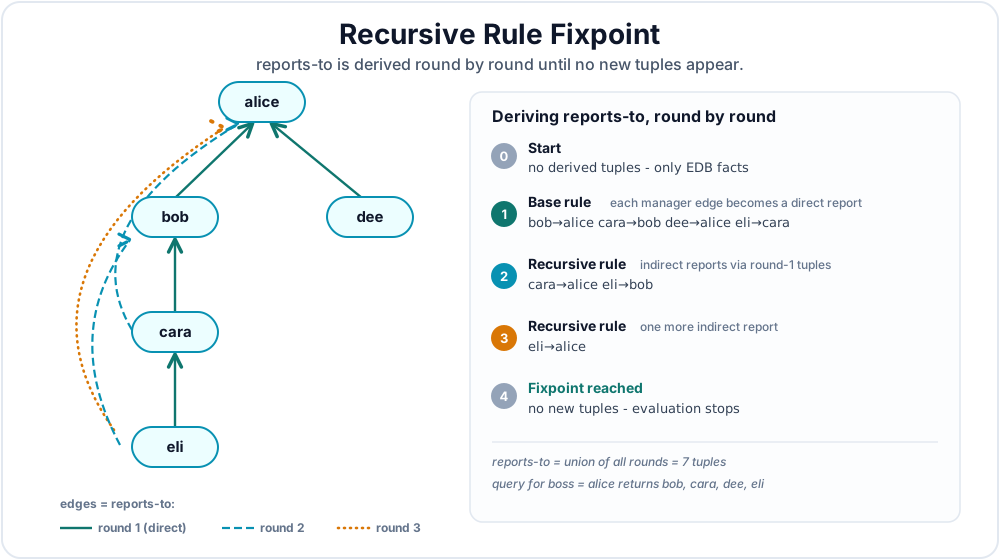
The stored facts are the EDB (extensional database): facts that are directly present in Datalevin. Written as [e a v] datoms with names instead of entity ids, the :employee/manager facts are:
[bob  :employee/manager alice]
[cara :employee/manager bob]
[dee  :employee/manager alice]
[eli  :employee/manager cara]
The rule predicate reports-to is the IDB (intensional database): tuples derived by applying rules to EDB facts and to previously derived IDB tuples. Before evaluation starts, there are no derived reports-to tuples: IDB round 0 = {}.
Round 1 applies the base rule:
[(reports-to ?sub ?boss)
 [?sub :employee/manager ?boss]]
Every direct manager fact becomes a direct reports-to tuple:
(reports-to bob  alice)
(reports-to cara bob)
(reports-to dee  alice)
(reports-to eli  cara)
Round 2 applies the recursive rule using the tuples discovered in round 1:
[(reports-to ?sub ?boss)
 [?sub :employee/manager ?intermediate]
 (reports-to ?intermediate ?boss)]
This produces the next layer of indirect reports:
(reports-to cara alice)  ; [cara :employee/manager bob] + (reports-to bob alice)
(reports-to eli  bob)    ; [eli :employee/manager cara] + (reports-to cara bob)
Round 3 repeats the recursive step with the new round-2 tuples:
(reports-to eli alice) ; [eli :employee/manager cara] + (reports-to cara alice)
Round 4 produces no new tuples, so evaluation has reached a fixpoint. The complete derived reports-to relation is the union of all IDB rounds:
(reports-to bob  alice)
(reports-to cara bob)
(reports-to dee  alice)
(reports-to eli  cara)
(reports-to cara alice)
(reports-to eli  bob)
(reports-to eli  alice)
The query asks only for tuples whose boss is Alice, so it returns Bob, Cara, Dee, and Eli. Chapter 21 explains how Datalevin evaluates recursive rules efficiently; the step-by-step illustration here is the conceptual model.
Termination is not validation
Datalevin's Datalog engine handles recursive expansion as a set of derived tuples, so cyclic data reaches a fixpoint instead of looping forever. Termination is not the same as data validity: if your domain requires a strict tree, your application or transaction functions should still prevent illegal management cycles.
6. Datalevin as a Reasoner: Bottom-Up Evaluation
Section 5 traced a recursive rule from direct manager facts to a fixpoint. That trace is Datalevin's rule evaluator at work: Datalevin evaluates rules bottom-up (see Chapter 21). In this mode, the database does not just store data; queries can infer new classifications or higher-level facts that were never explicitly transacted.
Bottom-up evaluation starts from base facts and repeatedly applies rules to discover derived tuples until no new tuples can be found. In rule-engine terminology, this is a forward-chaining style of reasoning: facts drive rule application, and rule application derives more facts. This still happens inside a query. Datalevin is not running a background job that stores inferred facts unless your application chooses to materialize those results.
This is different from Prolog-style backward chaining, where evaluation starts with a goal and recursively asks what subgoals could prove it. A Datalevin query names the rule relations it needs, but recursive rule evaluation itself is set-oriented and bottom-up. Chapter 21 explains how magic-set rewriting makes bottom-up evaluation goal-directed without turning it into backward chaining.
Expert systems make domain knowledge executable. Domain experts identify the concepts, relationships, constraints, and decision policies that matter, and the system applies that knowledge consistently to particular facts. An ontology makes the shared conceptual model explicit: what kinds of things exist in the domain, how they relate, and which distinctions the application needs to preserve. A knowledge graph supplies instances and observations in that model, while rules derive classifications and other consequences. In Datalevin, those consequences are query-time derived tuples unless the application explicitly materializes them.
This is a top-down approach to knowledge modeling: it begins with domain meaning and intended behavior, then organizes incoming evidence under that structure. It is a necessary complement to bottom-up, data-driven AI, which is excellent at discovering patterns, producing embeddings, extracting candidate facts, and making judgments under uncertainty. Data alone does not decide which vocabulary, policy, authority, or invariant an organization should adopt. In AI systems and human knowledge work alike, bottom-up methods help perceive and propose; top-down knowledge helps interpret, constrain, connect, and explain.
Here, top-down describes how domain knowledge enters the design, not how the query engine executes it. Datalevin still evaluates Datalog rules bottom-up, starting from facts and deriving tuples to a fixpoint. In Datalevin, ordinary facts and rules can themselves implement the application ontology: facts instantiate its concepts and relationships, while rules encode definitions and implications. An expert-authored ontology and a bottom-up rule evaluator therefore fit together naturally.
For experiments, tests, or services that do not need durable storage, an in-memory Datalevin connection can be a low-friction way to use Datalevin as a rule engine: load facts, pass rules as data, query the derived conclusions, and discard the connection when finished.
These ideas have a mature foundation in expert-system and production-system research [1,2,3]. Classic expert systems separated a knowledge base of facts and rules from an inference engine that derived conclusions. Datalevin's mechanism here is Datalog rule evaluation, not a production-system shell or a Rete implementation [2], but the modeling direction is similar: represent domain knowledge explicitly and derive higher-level facts from it. Chapter 5 discusses RDF and OWL ontologies and explains how Datalevin can also support a lighter, application-local ontology with attributes, entities, references, and rules.
6.1 Example: Automated Classification (Expert Systems)
Imagine an e-commerce system that needs to determine whether a user qualifies for "VIP status" based on a complex set of evolving business rules. Instead of hard-coding these rules in your application, you can define them as a rule set.
(def reasoning-rules
  '[;; Rule 1: High Spender
    [(is-high-spender? ?u)
     [?u :user/total-spent ?amount]
     [(> ?amount 5000)]]

    ;; Rule 2: Frequent Shopper
    [(is-frequent-shopper? ?u)
     [?u :user/order-count ?count]
     [(> ?count 20)]]

    ;; Gold: both qualifications hold
    [(vip-status ?u ?tier)
     (is-high-spender? ?u)
     (is-frequent-shopper? ?u)
     [(ground :gold) ?tier]]

    ;; Silver: exactly one qualification holds
    [(vip-status ?u ?tier)
     (or (is-high-spender? ?u)
         (is-frequent-shopper? ?u))
     (not-join [?u]
       (is-high-spender? ?u)
       (is-frequent-shopper? ?u))
     [(ground :silver) ?tier]]])
Object reasoningRules = Datalevin.edn("["
    // Rule 1: High Spender
    + "[(is-high-spender? ?u) "
    + "[?u :user/total-spent ?amount] "
    + "[(> ?amount 5000)]] "
    // Rule 2: Frequent Shopper
    + "[(is-frequent-shopper? ?u) "
    + "[?u :user/order-count ?count] "
    + "[(> ?count 20)]] "
    // Gold: both qualifications hold
    + "[(vip-status ?u ?tier) "
    + "(is-high-spender? ?u) "
    + "(is-frequent-shopper? ?u) "
    + "[(ground :gold) ?tier]] "
    // Silver: exactly one qualification holds
    + "[(vip-status ?u ?tier) "
    + "(or (is-high-spender? ?u) "
    + "    (is-frequent-shopper? ?u)) "
    + "(not-join [?u] "
    + "  (is-high-spender? ?u) "
    + "  (is-frequent-shopper? ?u)) "
    + "[(ground :silver) ?tier]]]");
u = q.var("u")
tier = q.var("tier")
amount = q.var("amount")
count = q.var("count")

reasoning_rules = q.rules(
    # Rule 1: High Spender
    q.rule_branch(
        "is-high-spender?",
        q.join_vars(u),
        q.datom(u, "user/total-spent", amount),
        q.predicate(">", amount, 5000),
    ),
    # Rule 2: Frequent Shopper
    q.rule_branch(
        "is-frequent-shopper?",
        q.join_vars(u),
        q.datom(u, "user/order-count", count),
        q.predicate(">", count, 20),
    ),
    # Gold: both qualifications hold
    q.rule_branch(
        "vip-status",
        q.join_vars(u, tier),
        q.rule("is-high-spender?", u),
        q.rule("is-frequent-shopper?", u),
        q.bind("ground", tier, q.kw("gold")),
    ),
    # Silver: exactly one qualification holds
    q.rule_branch(
        "vip-status",
        q.join_vars(u, tier),
        q.or_(
            q.rule("is-high-spender?", u),
            q.rule("is-frequent-shopper?", u),
        ),
        q.not_join(
            q.join_vars(u),
            q.rule("is-high-spender?", u),
            q.rule("is-frequent-shopper?", u),
        ),
        q.bind("ground", tier, q.kw("silver")),
    ),
)
const u = q.var("u");
const tier = q.var("tier");
const amount = q.var("amount");
const count = q.var("count");

const reasoningRules = q.rules(
  // Rule 1: High Spender
  q.ruleBranch(
    "is-high-spender?",
    q.joinVars(u),
    q.datom(u, "user/total-spent", amount),
    q.predicate(">", amount, 5000)
  ),
  // Rule 2: Frequent Shopper
  q.ruleBranch(
    "is-frequent-shopper?",
    q.joinVars(u),
    q.datom(u, "user/order-count", count),
    q.predicate(">", count, 20)
  ),
  // Gold: both qualifications hold
  q.ruleBranch(
    "vip-status",
    q.joinVars(u, tier),
    q.rule("is-high-spender?", u),
    q.rule("is-frequent-shopper?", u),
    q.bind("ground", tier, q.kw("gold"))
  ),
  // Silver: exactly one qualification holds
  q.ruleBranch(
    "vip-status",
    q.joinVars(u, tier),
    q.or(
      q.rule("is-high-spender?", u),
      q.rule("is-frequent-shopper?", u)
    ),
    q.notJoin(
      q.joinVars(u),
      q.rule("is-high-spender?", u),
      q.rule("is-frequent-shopper?", u)
    ),
    q.bind("ground", tier, q.kw("silver"))
  )
);
There are three derived relations here. is-high-spender? and is-frequent-shopper? each classify a user from stored attributes. vip-status combines those classifications and adds a tier. These are query-time relations: evaluating them does not transact new facts.
The two definitions of vip-status are alternative ways to derive a tuple with that rule head. They are combined like a logical OR; their source order does not give the gold definition precedence over the silver definition. Written as Boolean conditions, the intended policy is:
gold   = high-spender AND frequent-shopper
silver = (high-spender OR frequent-shopper)
         AND NOT (high-spender AND frequent-shopper)
The ground function is a built-in identity function used in binding clauses. It can bind a constant into a variable, or copy an already-bound value into a new variable. The clause [(ground :gold) ?tier] means "bind ?tier to :gold." A clause such as [(ground ?x) ?y], after ?x is bound, means "bind ?y to the same value as ?x." This is useful in rules because rule heads must expose variables, not raw constants.
The silver rule first uses or to require at least one qualification and bind ?u. It then uses not-join [?u] to ask whether the same user satisfies both qualifications. The clauses inside not-join form one conjunction. When that conjunction has a match, not-join fails and rejects the silver tuple. Without this exclusion, a user satisfying both definitions would derive both (vip-status ?u :gold) and (vip-status ?u :silver); rule order alone would not prevent that.
Rule order does not choose a tier
The two vip-status definitions form a union. The silver rule's
explicit not-join is what makes the tiers mutually exclusive;
reversing the definitions would produce the same results.
With data like this:
(d/transact! conn
  [{:user/id "u1" :user/total-spent 6000 :user/order-count 25}
   {:user/id "u2" :user/total-spent 6000 :user/order-count 1}
   {:user/id "u3" :user/total-spent 1    :user/order-count 25}])

(d/q '[:find ?id ?tier
       :in $ %
       :where [?u :user/id ?id]
              (vip-status ?u ?tier)]
     (d/db conn) reasoning-rules)
;; => #{["u1" :gold]
;;      ["u2" :silver]
;;      ["u3" :silver]}
conn.transact(Datalevin.tx()
    .entity(Tx.entity()
        .put(":user/id", "u1")
        .put(":user/total-spent", 6000L)
        .put(":user/order-count", 25L))
    .entity(Tx.entity()
        .put(":user/id", "u2")
        .put(":user/total-spent", 6000L)
        .put(":user/order-count", 1L))
    .entity(Tx.entity()
        .put(":user/id", "u3")
        .put(":user/total-spent", 1L)
        .put(":user/order-count", 25L)));

Object result = conn.query("[:find ?id ?tier " +
    ":in $ % " +
    ":where [?u :user/id ?id] " +
    "       (vip-status ?u ?tier)]",
    reasoningRules);
conn.transact(tx.data(
    tx.entity(-1, {"user/id": "u1", "user/total-spent": 6000,
                   "user/order-count": 25}),
    tx.entity(-2, {"user/id": "u2", "user/total-spent": 6000,
                   "user/order-count": 1}),
    tx.entity(-3, {"user/id": "u3", "user/total-spent": 1,
                   "user/order-count": 25}),
))

user_id = q.var("id")
result = conn.query(q.query(
    find=q.relation(user_id, tier),
    inputs=[q.DB, q.RULES],
    where=[
        q.datom(u, "user/id", user_id),
        q.rule("vip-status", u, tier),
    ],
), reasoning_rules)
await conn.transact(tx.data(
  tx.entity(-1, {
    "user/id": "u1", "user/total-spent": 6000, "user/order-count": 25
  }),
  tx.entity(-2, {
    "user/id": "u2", "user/total-spent": 6000, "user/order-count": 1
  }),
  tx.entity(-3, {
    "user/id": "u3", "user/total-spent": 1, "user/order-count": 25
  })
));

const userId = q.var("id");
const result = await conn.query(q.query({
  find: q.relation(userId, tier),
  inputs: [q.DB, q.RULES],
  where: [
    q.datom(u, "user/id", userId),
    q.rule("vip-status", u, tier)
  ]
}), reasoningRules);
The query declares two inputs with :in $ %: $ is the database and % is the rule set supplied as reasoning-rules. The database clause binds each internal entity id to the public :user/id, while (vip-status ?u ?tier) joins that entity with the derived classification.
The evaluator reaches the result as follows:
| User | High spender? | Frequent shopper? | Rule outcome |
|---|---|---|---|
u1 |
Yes (6000 > 5000) |
Yes (25 > 20) |
Gold succeeds; silver is excluded by not-join |
u2 |
Yes (6000 > 5000) |
No (1 <= 20) |
Gold fails; silver succeeds |
u3 |
No (1 <= 5000) |
Yes (25 > 20) |
Gold fails; silver succeeds |
A user who satisfies neither qualification derives no vip-status tuple and therefore does not appear in the result.
By querying (vip-status ?u ?tier), you are treating Datalevin as an expert system. The evaluator starts from the stored amount and order-count facts, derives the two qualifying relations, and then derives vip-status tuples. Those tuples are returned by this query but are not written back to the database.
This approach is useful because:
- Composability: You can build complex reasoning chains out of simple, testable rules.
- Performance: Reasoning happens inside the engine, using indexes and Datalevin's semi-naive evaluator (SNE). "Semi-naive" is the standard Datalog term for an evaluation strategy that tracks newly derived tuples instead of repeatedly recomputing everything. Chapter 21, Section 2 explains the execution model.
- Consistency: The "logic" of what defines a VIP is centralized in the rule set passed to queries, not scattered across microservices or application code modules.
7. Rules as an Abstraction Layer
Beyond their technical capabilities, rules serve as an abstraction layer for your domain logic.
Imagine a complex "Product Pricing" engine where the final price depends on user discounts, seasonal sales, and bulk quantities. Instead of putting this logic in your application code (which would require multiple round-trips to the database) or in each query, you can encode it as a rule set.
Here is a simplified rule set. It first derives candidate prices: the base price, plus one candidate for each applicable discount. The final calculated-price rule keeps only a candidate for which no better candidate exists.
(def pricing-rules
  '[[(price-candidate ?user ?product ?price)
     [?product :product/base-price ?price]]

    [(discount-rate ?user ?product ?rate)
     [?user :user/tier :gold]
     [(ground 0.20) ?rate]]

    [(discount-rate ?user ?product ?rate)
     [?product :product/category :clearance]
     [(ground 0.15) ?rate]]

    [(discount-rate ?user ?product ?rate)
     [?user :user/bulk-eligible? true]
     [?product :product/bulk? true]
     [(ground 0.10) ?rate]]

    [(price-candidate ?user ?product ?price)
     [?product :product/base-price ?base]
     (discount-rate ?user ?product ?rate)
     [(- 1.0 ?rate) ?multiplier]
     [(* ?base ?multiplier) ?price]]

    [(calculated-price ?user ?product ?price)
     (price-candidate ?user ?product ?price)
     (not-join [?user ?product ?price]
       (price-candidate ?user ?product ?better)
       [(< ?better ?price)])]])
Object pricingRules = Datalevin.edn("["
    + "[(price-candidate ?user ?product ?price) "
    + "[?product :product/base-price ?price]] "
    + "[(discount-rate ?user ?product ?rate) "
    + "[?user :user/tier :gold] "
    + "[(ground 0.20) ?rate]] "
    + "[(discount-rate ?user ?product ?rate) "
    + "[?product :product/category :clearance] "
    + "[(ground 0.15) ?rate]] "
    + "[(discount-rate ?user ?product ?rate) "
    + "[?user :user/bulk-eligible? true] "
    + "[?product :product/bulk? true] "
    + "[(ground 0.10) ?rate]] "
    + "[(price-candidate ?user ?product ?price) "
    + "[?product :product/base-price ?base] "
    + "(discount-rate ?user ?product ?rate) "
    + "[(- 1.0 ?rate) ?multiplier] "
    + "[(* ?base ?multiplier) ?price]] "
    + "[(calculated-price ?user ?product ?price) "
    + "(price-candidate ?user ?product ?price) "
    + "(not-join [?user ?product ?price] "
    + "  (price-candidate ?user ?product ?better) "
    + "  [(< ?better ?price)])]]");
user = q.var("user")
product = q.var("product")
price = q.var("price")
rate = q.var("rate")
base = q.var("base")
multiplier = q.var("multiplier")
better = q.var("better")
price_args = q.join_vars(user, product, price)
rate_args = q.join_vars(user, product, rate)

pricing_rules = q.rules(
    q.rule_branch(
        "price-candidate",
        price_args,
        q.datom(product, "product/base-price", price),
    ),
    q.rule_branch(
        "discount-rate",
        rate_args,
        q.datom(user, "user/tier", q.kw("gold")),
        q.bind("ground", rate, 0.20),
    ),
    q.rule_branch(
        "discount-rate",
        rate_args,
        q.datom(product, "product/category", q.kw("clearance")),
        q.bind("ground", rate, 0.15),
    ),
    q.rule_branch(
        "discount-rate",
        rate_args,
        q.datom(user, "user/bulk-eligible?", True),
        q.datom(product, "product/bulk?", True),
        q.bind("ground", rate, 0.10),
    ),
    q.rule_branch(
        "price-candidate",
        price_args,
        q.datom(product, "product/base-price", base),
        q.rule("discount-rate", user, product, rate),
        q.bind("-", multiplier, 1.0, rate),
        q.bind("*", price, base, multiplier),
    ),
    q.rule_branch(
        "calculated-price",
        price_args,
        q.rule("price-candidate", user, product, price),
        q.not_join(
            q.join_vars(user, product, price),
            q.rule("price-candidate", user, product, better),
            q.predicate("<", better, price),
        ),
    ),
)
const user = q.var("user");
const product = q.var("product");
const price = q.var("price");
const rate = q.var("rate");
const base = q.var("base");
const multiplier = q.var("multiplier");
const better = q.var("better");
const priceArgs = q.joinVars(user, product, price);
const rateArgs = q.joinVars(user, product, rate);

const pricingRules = q.rules(
  q.ruleBranch(
    "price-candidate",
    priceArgs,
    q.datom(product, "product/base-price", price)
  ),
  q.ruleBranch(
    "discount-rate",
    rateArgs,
    q.datom(user, "user/tier", q.kw("gold")),
    q.bind("ground", rate, 0.20)
  ),
  q.ruleBranch(
    "discount-rate",
    rateArgs,
    q.datom(product, "product/category", q.kw("clearance")),
    q.bind("ground", rate, 0.15)
  ),
  q.ruleBranch(
    "discount-rate",
    rateArgs,
    q.datom(user, "user/bulk-eligible?", true),
    q.datom(product, "product/bulk?", true),
    q.bind("ground", rate, 0.10)
  ),
  q.ruleBranch(
    "price-candidate",
    priceArgs,
    q.datom(product, "product/base-price", base),
    q.rule("discount-rate", user, product, rate),
    q.bind("-", multiplier, 1.0, rate),
    q.bind("*", price, base, multiplier)
  ),
  q.ruleBranch(
    "calculated-price",
    priceArgs,
    q.rule("price-candidate", user, product, price),
    q.notJoin(
      q.joinVars(user, product, price),
      q.rule("price-candidate", user, product, better),
      q.predicate("<", better, price)
    )
  )
);
This example uses floating-point prices to keep the arithmetic readable. In a production money model, prefer integer cents or a decimal representation and write the rule arithmetic accordingly.
Now the application query stays focused on intent:
(d/q '[:find ?product-id ?final-price
       :in $ % ?user-id
       :where [?user :user/id ?user-id]
              [?product :product/id ?product-id]
              (calculated-price ?user ?product ?final-price)]
     db pricing-rules "u-123")
Object result = conn.query("[:find ?product-id ?final-price " +
    ":in $ % ?user-id " +
    ":where [?user :user/id ?user-id] " +
    "       [?product :product/id ?product-id] " +
    "       (calculated-price ?user ?product ?final-price)]",
    pricingRules, "u-123");
user_id = q.var("user-id")
product_id = q.var("product-id")
final_price = q.var("final-price")
result = conn.query(q.query(
    find=q.relation(product_id, final_price),
    inputs=[q.DB, q.RULES, user_id],
    where=[
        q.datom(user, "user/id", user_id),
        q.datom(product, "product/id", product_id),
        q.rule("calculated-price", user, product, final_price),
    ],
), pricing_rules, "u-123")
const userId = q.var("user-id");
const productId = q.var("product-id");
const finalPrice = q.var("final-price");
const result = await conn.query(q.query({
  find: q.relation(productId, finalPrice),
  inputs: [q.DB, q.RULES, userId],
  where: [
    q.datom(user, "user/id", userId),
    q.datom(product, "product/id", productId),
    q.rule("calculated-price", user, product, finalPrice)
  ]
}), pricingRules, "u-123");
The query does not need to know whether the price came from a gold-tier discount, a clearance discount, a bulk discount, or no discount at all. If the business adds a new discount rule, you add another discount-rate definition and keep the query shape stable.
This keeps pricing consistent, evaluates the calculation close to the data, and lets application code stay focused on query intent.
8. Benchmark Context
Datalevin's portable OpenRuleBench suite exercises transitive closure, same-generation recursion, and nonrecursive join trees across Datalevin, SQL databases, XSB, Soufflé, and Clojure rule engines [4]. It uses deterministic set-valued inputs, verifies input digests and result counts, and times query evaluation through complete result realization.
In the representative run, Datalevin had the lowest measured latency on all ten supported tasks. This is self-published workload evidence, not a universal ranking: supported tasks differ, generated-program preparation and compilation are outside the timer, and scale, cache state, and runtime settings affect the result. See [4] for the full timings and reproduction instructions.
Summary
Rules transform Datalog from a simple pattern-matching language into an expressive tool for knowledge derivation.
- Encapsulation: Wrap complex
:whereclauses in a named rule. - Reusability: Define logic once and use it across many queries.
- Named alternatives: Express branching domain logic once instead of repeating
orblocks across queries. - Parameters and bindings: Use rules as relations whose arguments may be inputs, outputs, or both.
- Recursion: Traverse graphs and hierarchies without fixed-depth joins.
- Derivation: Treat rule sets as query-time reasoners that classify and derive facts from base data.
- Abstraction layer: Put domain calculations behind named rules so application queries can stay focused on intent.
Chapter 13 develops these patterns further for graph data.
References
[1] Stuart Russell and Peter Norvig, Artificial Intelligence: A Modern Approach, 4th US ed., Pearson, 2020. URL: https://aima.cs.berkeley.edu/.
[2] Charles L. Forgy, "Rete: A Fast Algorithm for the Many Pattern/Many Object Pattern Match Problem," Artificial Intelligence 19(1):17-37, 1982. DOI: https://doi.org/10.1016/0004-3702(82)90020-0.
[3] Peter Jackson, Introduction to Expert Systems, 3rd ed., Addison-Wesley, 1998.
[4] Datalevin project, "Portable OpenRuleBench Tasks," benchmark harness, methodology, representative results, and reproduction instructions. URL: https://github.com/datalevin/datalevin/tree/master/benchmarks/openrulebench.
User Examples
Log in to create examplesNo examples for this chapter yet.