
Chapter 13: Graph Modeling
In many databases, "graph" is a specialized mode or a separate engine. In Datalevin, graph-shaped data is part of the normal fact model. Every :db.type/ref you define is a directed edge between two nodes (entities).
Graph cost follows fan-out
Because Datalevin maintains EAV and AVE indexes, both forward and reverse navigation have indexed access paths. Actual cost still depends on fan-out, selectivity, and result size: an indexed edge that reaches millions of neighbors still returns millions of candidates.
This chapter shows how to use Datalevin for graph-shaped data, focusing on navigation, recursive patterns, and modeling complex relationships.
1. Entities as Nodes, Refs as Edges
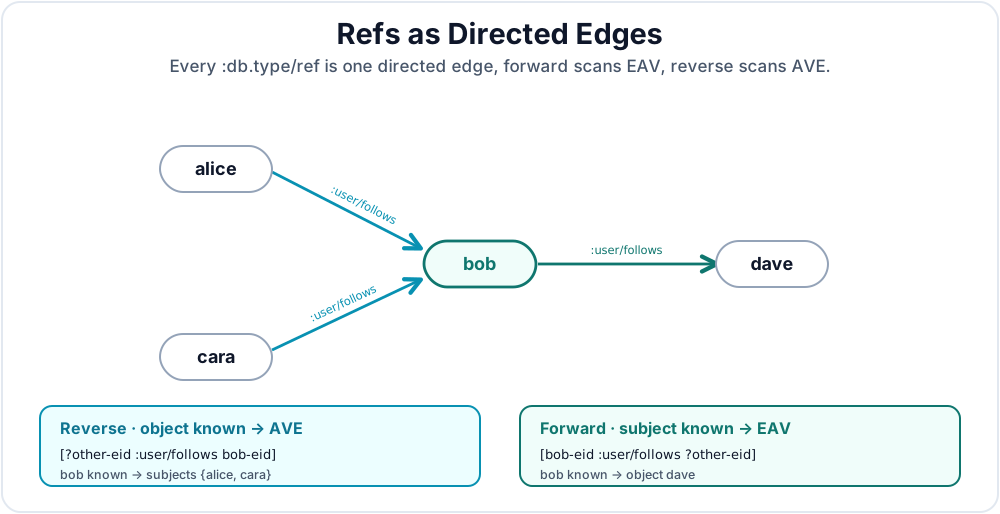
Figure 13.1 depicts a graph model as a network of interconnected entities.
- Nodes: Entities with their properties (attributes).
- Edges: Reference attributes (
:db.type/ref) that point from one entity to another.
1.1 Forward and Reverse Navigation
Datalevin allows you to traverse relationships in both directions without any additional indexing. The query planner chooses the right index for navigation:
- Forward: Starting from the known entity position and following a reference attribute to the value position using the EAV index.
- Pattern:
[?bound-eid :user/follows ?unknown-eid]
- Pattern:
- Reverse: Starting from a known value position and finding entities whose reference attribute has that value using the AVE index.
- Pattern:
[?unknown-eid :user/follows ?bound-eid]
- Pattern:
This works well because most queries in a well-designed data model know the attribute they are traversing.
2. Modeling Complex Edges (Join Entities)
In a simple graph, an edge can be a direct reference such as :user/follows. When the edge itself has facts, promote the edge to an entity. Property-graph literature models this as an edge with properties. In Datalevin, model it as a join entity: ordinary entities connected by ordinary ref attributes.
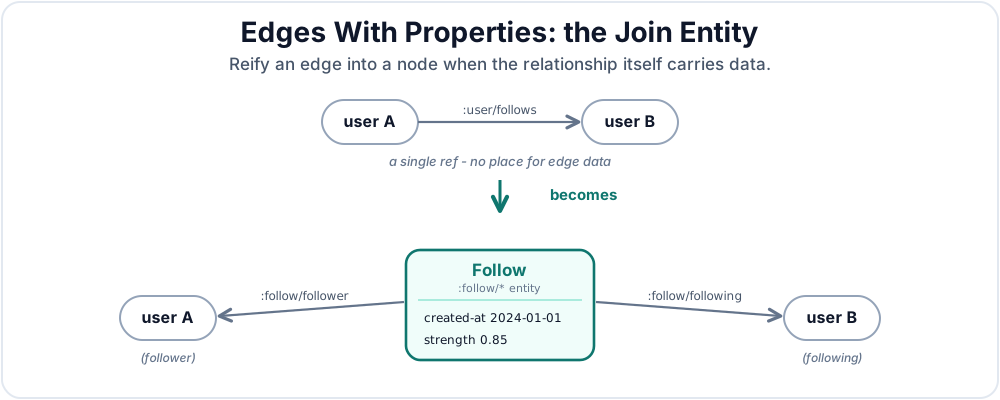
In Figure 13.2, the direct edge A -> B becomes a Follow entity with two refs, :follow/follower and :follow/following, plus facts such as :follow/created-at or :follow/strength. This gives you property-graph-style modeling [1] while keeping Datalevin's normalized fact representation [2]. Chapter 12 shows the same move in ER examples such as memberships, line items, and enrollments.
3. Graph Traversal Patterns
Graph queries range from fixed-depth joins to recursive reachability, branching path shapes, and exclusions. Datalevin uses ordinary Datalog joins for fixed-depth traversals, recursive rules for paths of arbitrary length, and or-join or not-join when graph shapes branch or exclude one another.
Fixed-depth traversals are ordinary joins. To find people followed by the people you follow:
(d/q '[:find ?suggestion-eid
       :in $ ?user-eid
       :where
       [?user-eid :user/follows ?intermediate-eid]
       [?intermediate-eid :user/follows ?suggestion-eid]
       [(not= ?user-eid ?suggestion-eid)]]
     db user-eid)
Object suggestions = conn.query(
    "[:find ?suggestion-eid " +
    " :in $ ?user-eid " +
    " :where [?user-eid :user/follows ?intermediate-eid] " +
    "        [?intermediate-eid :user/follows ?suggestion-eid] " +
    "        [(not= ?user-eid ?suggestion-eid)]]",
    userEid);
from datalevin import q

user = q.var("user-eid")
intermediate = q.var("intermediate-eid")
suggestion = q.var("suggestion-eid")
suggestions = conn.query(q.query(
    find=q.relation(suggestion),
    inputs=[q.DB, user],
    where=[
        q.datom(user, "user/follows", intermediate),
        q.datom(intermediate, "user/follows", suggestion),
        q.predicate("not=", user, suggestion),
    ],
), user_eid)
import { q } from "datalevin-node";

const user = q.var("user-eid");
const intermediate = q.var("intermediate-eid");
const suggestion = q.var("suggestion-eid");
const suggestions = await conn.query(q.query({
  find: q.relation(suggestion),
  inputs: [q.DB, user],
  where: [
    q.datom(user, "user/follows", intermediate),
    q.datom(intermediate, "user/follows", suggestion),
    q.predicate("not=", user, suggestion)
  ]
}), userEid);
3.1 Deep Traversal: Transitive Closure
Transitive closure means the full set of nodes reachable by following the same edge relation one or more times. Add a reflexive base case when the start node should also count as reachable from itself. In practical terms, transitive closure is how you find connections at any distance, such as all reachable nodes in a network. Use recursive rules for transitive closure:
(def reachability-rules
  '[[(reachable ?start-eid ?end-eid)
     [?start-eid :link/to ?end-eid]]

    [(reachable ?start-eid ?end-eid)
     [?start-eid :link/to ?mid-eid]
     (reachable ?mid-eid ?end-eid)]])
Object reachabilityRules = Datalevin.edn(
    "[[(reachable ?start-eid ?end-eid) " +
    "  [?start-eid :link/to ?end-eid]] " +
    " [(reachable ?start-eid ?end-eid) " +
    "  [?start-eid :link/to ?mid-eid] " +
    "  (reachable ?mid-eid ?end-eid)]]");
start = q.var("start-eid")
end = q.var("end-eid")
mid = q.var("mid-eid")
reachable_args = q.join_vars(start, end)
reachability_rules = q.rules(
    q.rule_branch(
        "reachable", reachable_args,
        q.datom(start, "link/to", end),
    ),
    q.rule_branch(
        "reachable", reachable_args,
        q.datom(start, "link/to", mid),
        q.rule("reachable", mid, end),
    ),
)
const start = q.var("start-eid");
const end = q.var("end-eid");
const mid = q.var("mid-eid");
const reachableArgs = q.joinVars(start, end);
const reachabilityRules = q.rules(
  q.ruleBranch(
    "reachable", reachableArgs,
    q.datom(start, "link/to", end)
  ),
  q.ruleBranch(
    "reachable", reachableArgs,
    q.datom(start, "link/to", mid),
    q.rule("reachable", mid, end)
  )
);
Datalevin evaluates recursive rules to a fixpoint: the point where another round of rule evaluation produces no new result tuples. That means cyclic data does not create a recursive call-stack loop. A fixpoint can still contain many derived tuples, so constrain broad traversals with selective starting facts, bounded rules, or application-level limits when the graph can fan out widely.
3.2 Hierarchies and Taxonomies
Recursive rules are also a natural fit for tree-like graph structures. The same pattern works for place hierarchies, product categories, organization charts, and tag taxonomies. A city belongs to a country through :place/isPartOf, and a tag class belongs to a broader class through :tagclass/isSubclassOf.
(def place-country-rules
  '[[(place-country ?place-eid ?country-eid)
     [?place-eid :place/type "Country"]
     [(ground ?place-eid) ?country-eid]]

    [(place-country ?place-eid ?country-eid)
     [?place-eid :place/isPartOf ?parent-eid]
     (place-country ?parent-eid ?country-eid)]])

(d/q '[:find ?country-name
       :in $ % ?place-name
       :where
       [?place-eid :place/name ?place-name]
       (place-country ?place-eid ?country-eid)
       [?country-eid :place/name ?country-name]]
     db place-country-rules "Paris")
Object placeCountryRules = Datalevin.edn(
    "[[(place-country ?place-eid ?country-eid) " +
    "  [?place-eid :place/type \"Country\"] " +
    "  [(ground ?place-eid) ?country-eid]] " +
    " [(place-country ?place-eid ?country-eid) " +
    "  [?place-eid :place/isPartOf ?parent-eid] " +
    "  (place-country ?parent-eid ?country-eid)]]");

Object result = conn.query("[:find ?country-name " +
    ":in $ % ?place-name " +
    ":where [?place-eid :place/name ?place-name] " +
    "       (place-country ?place-eid ?country-eid) " +
    "       [?country-eid :place/name ?country-name]]",
    placeCountryRules, "Paris");
place = q.var("place-eid")
country = q.var("country-eid")
parent = q.var("parent-eid")
place_name = q.var("place-name")
country_name = q.var("country-name")
place_country_args = q.join_vars(place, country)

place_country_rules = q.rules(
    q.rule_branch(
        "place-country", place_country_args,
        q.datom(place, "place/type", "Country"),
        q.bind("ground", country, place),
    ),
    q.rule_branch(
        "place-country", place_country_args,
        q.datom(place, "place/isPartOf", parent),
        q.rule("place-country", parent, country),
    ),
)

result = conn.query(q.query(
    find=q.relation(country_name),
    inputs=[q.DB, q.RULES, place_name],
    where=[
        q.datom(place, "place/name", place_name),
        q.rule("place-country", place, country),
        q.datom(country, "place/name", country_name),
    ],
), place_country_rules, "Paris")
const place = q.var("place-eid");
const country = q.var("country-eid");
const parent = q.var("parent-eid");
const placeName = q.var("place-name");
const countryName = q.var("country-name");
const placeCountryArgs = q.joinVars(place, country);

const placeCountryRules = q.rules(
  q.ruleBranch(
    "place-country", placeCountryArgs,
    q.datom(place, "place/type", "Country"),
    q.bind("ground", country, place)
  ),
  q.ruleBranch(
    "place-country", placeCountryArgs,
    q.datom(place, "place/isPartOf", parent),
    q.rule("place-country", parent, country)
  )
);

const result = await conn.query(q.query({
  find: q.relation(countryName),
  inputs: [q.DB, q.RULES, placeName],
  where: [
    q.datom(place, "place/name", placeName),
    q.rule("place-country", place, country),
    q.datom(country, "place/name", countryName)
  ]
}), placeCountryRules, "Paris");
The base case uses [(ground ?place-eid) ?country-eid] as an identity binding: after ?place-eid is known to be a country, the rule copies that entity id into ?country-eid. In other words, a country is its own country for the purpose of this rule, while non-country places recurse through :place/isPartOf.
This rule works for both direct and indirect containment. If Paris is part of France, and France is part of Europe, the rule stops at the first ancestor whose :place/type is "Country".
3.3 Bounded Neighborhoods with Distance
Some graph queries should not traverse arbitrarily far. They ask for neighbors within a fixed radius, while preserving the distance so the final result can be ordered or aggregated.
Listing 13.1 shows one bounded-neighborhood pattern: unroll the fixed distances into separate rule bodies and bind the distance explicitly.
In this example, friendship is a join entity with two reference attributes, :knows/person1 and :knows/person2, following the Section 2 pattern. This is also how LDBC SNB models friendship. The queries treat the edge as directional from :knows/person1 to :knows/person2; for mutual friendship, store both orientations or query both orientations.
(def friends-3-rules
  '[[(friends-3 ?start-eid ?friend-eid ?dist)
     [?knows-eid :knows/person1 ?start-eid]
     [?knows-eid :knows/person2 ?friend-eid]
     [(ground 1) ?dist]]

    [(friends-3 ?start-eid ?friend-eid ?dist)
     [?knows1-eid :knows/person1 ?start-eid]
     [?knows1-eid :knows/person2 ?mid-eid]
     [?knows2-eid :knows/person1 ?mid-eid]
     [?knows2-eid :knows/person2 ?friend-eid]
     [(not= ?friend-eid ?start-eid)]
     [(ground 2) ?dist]]

    [(friends-3 ?start-eid ?friend-eid ?dist)
     [?knows1-eid :knows/person1 ?start-eid]
     [?knows1-eid :knows/person2 ?mid1-eid]
     [?knows2-eid :knows/person1 ?mid1-eid]
     [?knows2-eid :knows/person2 ?mid2-eid]
     [(not= ?mid2-eid ?start-eid)]
     [?knows3-eid :knows/person1 ?mid2-eid]
     [?knows3-eid :knows/person2 ?friend-eid]
     [(not= ?friend-eid ?start-eid)]
     [(not= ?friend-eid ?mid1-eid)]
     [(ground 3) ?dist]]])

(d/q '[:find (min ?dist) ?friend-id
       :in $ % ?person-id
       :where
       [?start-eid :person/id ?person-id]
       (friends-3 ?start-eid ?friend-eid ?dist)
       [?friend-eid :person/id ?friend-id]]
     db friends-3-rules person-id)
Object friends3Rules = Datalevin.edn(
    "[[(friends-3 ?start-eid ?friend-eid ?dist) " +
    "  [?knows-eid :knows/person1 ?start-eid] " +
    "  [?knows-eid :knows/person2 ?friend-eid] " +
    "  [(ground 1) ?dist]] " +
    " [(friends-3 ?start-eid ?friend-eid ?dist) " +
    "  [?knows1-eid :knows/person1 ?start-eid] " +
    "  [?knows1-eid :knows/person2 ?mid-eid] " +
    "  [?knows2-eid :knows/person1 ?mid-eid] " +
    "  [?knows2-eid :knows/person2 ?friend-eid] " +
    "  [(not= ?friend-eid ?start-eid)] " +
    "  [(ground 2) ?dist]] " +
    " [(friends-3 ?start-eid ?friend-eid ?dist) " +
    "  [?knows1-eid :knows/person1 ?start-eid] " +
    "  [?knows1-eid :knows/person2 ?mid1-eid] " +
    "  [?knows2-eid :knows/person1 ?mid1-eid] " +
    "  [?knows2-eid :knows/person2 ?mid2-eid] " +
    "  [(not= ?mid2-eid ?start-eid)] " +
    "  [?knows3-eid :knows/person1 ?mid2-eid] " +
    "  [?knows3-eid :knows/person2 ?friend-eid] " +
    "  [(not= ?friend-eid ?start-eid)] " +
    "  [(not= ?friend-eid ?mid1-eid)] " +
    "  [(ground 3) ?dist]]]");

Object result = conn.query("[:find (min ?dist) ?friend-id " +
    ":in $ % ?person-id " +
    ":where [?start-eid :person/id ?person-id] " +
    "       (friends-3 ?start-eid ?friend-eid ?dist) " +
    "       [?friend-eid :person/id ?friend-id]]",
    friends3Rules, personId);
start = q.var("start-eid")
friend = q.var("friend-eid")
dist = q.var("dist")
knows = q.var("knows-eid")
knows1 = q.var("knows1-eid")
knows2 = q.var("knows2-eid")
knows3 = q.var("knows3-eid")
mid = q.var("mid-eid")
mid1 = q.var("mid1-eid")
mid2 = q.var("mid2-eid")
friends_args = q.join_vars(start, friend, dist)

friends_3_rules = q.rules(
    q.rule_branch(
        "friends-3", friends_args,
        q.datom(knows, "knows/person1", start),
        q.datom(knows, "knows/person2", friend),
        q.bind("ground", dist, 1),
    ),
    q.rule_branch(
        "friends-3", friends_args,
        q.datom(knows1, "knows/person1", start),
        q.datom(knows1, "knows/person2", mid),
        q.datom(knows2, "knows/person1", mid),
        q.datom(knows2, "knows/person2", friend),
        q.predicate("not=", friend, start),
        q.bind("ground", dist, 2),
    ),
    q.rule_branch(
        "friends-3", friends_args,
        q.datom(knows1, "knows/person1", start),
        q.datom(knows1, "knows/person2", mid1),
        q.datom(knows2, "knows/person1", mid1),
        q.datom(knows2, "knows/person2", mid2),
        q.predicate("not=", mid2, start),
        q.datom(knows3, "knows/person1", mid2),
        q.datom(knows3, "knows/person2", friend),
        q.predicate("not=", friend, start),
        q.predicate("not=", friend, mid1),
        q.bind("ground", dist, 3),
    ),
)

friend_id = q.var("friend-id")
person_id_input = q.var("person-id")
result = conn.query(q.query(
    find=q.relation(q.aggregate("min", dist), friend_id),
    inputs=[q.DB, q.RULES, person_id_input],
    where=[
        q.datom(start, "person/id", person_id_input),
        q.rule("friends-3", start, friend, dist),
        q.datom(friend, "person/id", friend_id),
    ],
), friends_3_rules, person_id)
const start = q.var("start-eid");
const friend = q.var("friend-eid");
const dist = q.var("dist");
const knows = q.var("knows-eid");
const knows1 = q.var("knows1-eid");
const knows2 = q.var("knows2-eid");
const knows3 = q.var("knows3-eid");
const mid = q.var("mid-eid");
const mid1 = q.var("mid1-eid");
const mid2 = q.var("mid2-eid");
const friendsArgs = q.joinVars(start, friend, dist);

const friends3Rules = q.rules(
  q.ruleBranch(
    "friends-3", friendsArgs,
    q.datom(knows, "knows/person1", start),
    q.datom(knows, "knows/person2", friend),
    q.bind("ground", dist, 1)
  ),
  q.ruleBranch(
    "friends-3", friendsArgs,
    q.datom(knows1, "knows/person1", start),
    q.datom(knows1, "knows/person2", mid),
    q.datom(knows2, "knows/person1", mid),
    q.datom(knows2, "knows/person2", friend),
    q.predicate("not=", friend, start),
    q.bind("ground", dist, 2)
  ),
  q.ruleBranch(
    "friends-3", friendsArgs,
    q.datom(knows1, "knows/person1", start),
    q.datom(knows1, "knows/person2", mid1),
    q.datom(knows2, "knows/person1", mid1),
    q.datom(knows2, "knows/person2", mid2),
    q.predicate("not=", mid2, start),
    q.datom(knows3, "knows/person1", mid2),
    q.datom(knows3, "knows/person2", friend),
    q.predicate("not=", friend, start),
    q.predicate("not=", friend, mid1),
    q.bind("ground", dist, 3)
  )
);

const friendId = q.var("friend-id");
const personIdInput = q.var("person-id");
const result = await conn.query(q.query({
  find: q.relation(q.aggregate("min", dist), friendId),
  inputs: [q.DB, q.RULES, personIdInput],
  where: [
    q.datom(start, "person/id", personIdInput),
    q.rule("friends-3", start, friend, dist),
    q.datom(friend, "person/id", friendId)
  ]
}), friends3Rules, personId);
The rule emits one row for each path shape. The query uses (min ?dist) to keep the shortest distance for each reachable person.
3.4 Mutual Recursion: Alternating Edge Types
Some graph traversals are not a single repeated edge. Datalevin's rule engine also supports mutually recursive rules, where two or more rules call each other until the result reaches a fixpoint. This pattern is useful for alternating path semantics.
For example, suppose a graph has two edge types, :edge/a and :edge/b, and you want to find paths that end with an :edge/a step after alternating between the two edge types:
(def alternating-rules
  '[[(path-a ?from-eid ?to-eid)
     [?from-eid :edge/a ?to-eid]]

    [(path-a ?from-eid ?to-eid)
     [?mid-eid :edge/a ?to-eid]
     (path-b ?from-eid ?mid-eid)]

    [(path-b ?from-eid ?to-eid)
     [?from-eid :edge/b ?to-eid]]

    [(path-b ?from-eid ?to-eid)
     [?mid-eid :edge/b ?to-eid]
     (path-a ?from-eid ?mid-eid)]])

(d/q '[:find ?to-eid
       :in $ % ?from-eid
       :where
       (path-a ?from-eid ?to-eid)]
     db alternating-rules start-eid)
Object alternatingRules = Datalevin.edn(
    "[[(path-a ?from-eid ?to-eid) " +
    "  [?from-eid :edge/a ?to-eid]] " +
    " [(path-a ?from-eid ?to-eid) " +
    "  [?mid-eid :edge/a ?to-eid] " +
    "  (path-b ?from-eid ?mid-eid)] " +
    " [(path-b ?from-eid ?to-eid) " +
    "  [?from-eid :edge/b ?to-eid]] " +
    " [(path-b ?from-eid ?to-eid) " +
    "  [?mid-eid :edge/b ?to-eid] " +
    "  (path-a ?from-eid ?mid-eid)]]");

Object result = conn.query(
    "[:find ?to-eid " +
    " :in $ % ?from-eid " +
    " :where (path-a ?from-eid ?to-eid)]",
    alternatingRules,
    startEid);
from_eid = q.var("from-eid")
to_eid = q.var("to-eid")
mid_eid = q.var("mid-eid")
path_args = q.join_vars(from_eid, to_eid)

alternating_rules = q.rules(
    q.rule_branch(
        "path-a", path_args,
        q.datom(from_eid, "edge/a", to_eid),
    ),
    q.rule_branch(
        "path-a", path_args,
        q.datom(mid_eid, "edge/a", to_eid),
        q.rule("path-b", from_eid, mid_eid),
    ),
    q.rule_branch(
        "path-b", path_args,
        q.datom(from_eid, "edge/b", to_eid),
    ),
    q.rule_branch(
        "path-b", path_args,
        q.datom(mid_eid, "edge/b", to_eid),
        q.rule("path-a", from_eid, mid_eid),
    ),
)

result = conn.query(q.query(
    find=q.relation(to_eid),
    inputs=[q.DB, q.RULES, from_eid],
    where=[q.rule("path-a", from_eid, to_eid)],
), alternating_rules, start_eid)
const fromEid = q.var("from-eid");
const toEid = q.var("to-eid");
const midEid = q.var("mid-eid");
const pathArgs = q.joinVars(fromEid, toEid);

const alternatingRules = q.rules(
  q.ruleBranch(
    "path-a", pathArgs,
    q.datom(fromEid, "edge/a", toEid)
  ),
  q.ruleBranch(
    "path-a", pathArgs,
    q.datom(midEid, "edge/a", toEid),
    q.rule("path-b", fromEid, midEid)
  ),
  q.ruleBranch(
    "path-b", pathArgs,
    q.datom(fromEid, "edge/b", toEid)
  ),
  q.ruleBranch(
    "path-b", pathArgs,
    q.datom(midEid, "edge/b", toEid),
    q.rule("path-a", fromEid, midEid)
  )
);

const result = await conn.query(q.query({
  find: q.relation(toEid),
  inputs: [q.DB, q.RULES, fromEid],
  where: [q.rule("path-a", fromEid, toEid)]
}), alternatingRules, startEid);
path-a depends on path-b, and path-b depends on path-a. Datalevin evaluates these rules together, rather than expanding one call stack top-down. That is what allows mutually recursive graph definitions to remain practical.
3.5 Branching Traversals with or-join
Complex queries often need to combine several graph shapes into one logical binding. For graph neighborhoods such as "people within two hops" from a start person, where a person can be reached either directly or through one intermediate friend, or-join can be used to cover the alternatives:
(d/q '[:find ?person-eid
       :in $ ?person-id
       :where
       [?start-eid :person/id ?person-id]
       (or-join [?start-eid ?person-eid]
                ;; one hop
                (and [?knows-eid :knows/person1 ?start-eid]
                     [?knows-eid :knows/person2 ?person-eid])

                ;; two hops
                (and [?knows1-eid :knows/person1 ?start-eid]
                     [?knows1-eid :knows/person2 ?mid-eid]
                     [?knows2-eid :knows/person1 ?mid-eid]
                     [?knows2-eid :knows/person2 ?person-eid]
                     [(not= ?person-eid ?start-eid)]))]
     db person-id)
Object result = conn.query(
    "[:find ?person-eid " +
    " :in $ ?person-id " +
    " :where [?start-eid :person/id ?person-id] " +
    "        (or-join [?start-eid ?person-eid] " +
    "          (and [?knows-eid :knows/person1 ?start-eid] " +
    "               [?knows-eid :knows/person2 ?person-eid]) " +
    "          (and [?knows1-eid :knows/person1 ?start-eid] " +
    "               [?knows1-eid :knows/person2 ?mid-eid] " +
    "               [?knows2-eid :knows/person1 ?mid-eid] " +
    "               [?knows2-eid :knows/person2 ?person-eid] " +
    "               [(not= ?person-eid ?start-eid)]))]",
    personId);
from datalevin import q

(person, person_id_var, start, knows, knows_1, knows_2, middle) = map(
    q.var,
    ("person-eid", "person-id", "start-eid", "knows-eid",
     "knows1-eid", "knows2-eid", "mid-eid"),
)
result = conn.query(q.query(
    find=q.relation(person),
    inputs=[q.DB, person_id_var],
    where=[
        q.datom(start, "person/id", person_id_var),
        q.or_join(
            q.join_vars(start, person),
            q.and_(
                q.datom(knows, "knows/person1", start),
                q.datom(knows, "knows/person2", person),
            ),
            q.and_(
                q.datom(knows_1, "knows/person1", start),
                q.datom(knows_1, "knows/person2", middle),
                q.datom(knows_2, "knows/person1", middle),
                q.datom(knows_2, "knows/person2", person),
                q.predicate("not=", person, start),
            ),
        ),
    ],
), person_id)
import { q } from "datalevin-node";

const person = q.var("person-eid");
const personIdVar = q.var("person-id");
const start = q.var("start-eid");
const knows = q.var("knows-eid");
const knows1 = q.var("knows1-eid");
const knows2 = q.var("knows2-eid");
const middle = q.var("mid-eid");
const result = await conn.query(q.query({
  find: q.relation(person),
  inputs: [q.DB, personIdVar],
  where: [
    q.datom(start, "person/id", personIdVar),
    q.orJoin(
      q.joinVars(start, person),
      q.and(
        q.datom(knows, "knows/person1", start),
        q.datom(knows, "knows/person2", person)
      ),
      q.and(
        q.datom(knows1, "knows/person1", start),
        q.datom(knows1, "knows/person2", middle),
        q.datom(knows2, "knows/person1", middle),
        q.datom(knows2, "knows/person2", person),
        q.predicate("not=", person, start)
      )
    )
  ]
}), personId);
Use or-join when the alternatives bind the same logical result through different graph patterns. The join variables, here ?start-eid and ?person-eid, tell the query engine which values must be shared between the branch and the rest of the query. Each or-join branch that contains more than one clause is wrapped in (and ...), because the branch itself must be one syntactic alternative. This is especially useful before aggregating over messages, forums, tags, or memberships reached through several allowed path shapes.
3.6 Excluding Graph Shapes with not-join
Recommendation queries often need an anti-join: keep candidates from one pattern only when no matching fact exists in another pattern. In graph terms, this means finding nodes reachable by one path, but excluding nodes reachable by another path. A common example is friends-of-friends who are not already direct friends.
(d/q '[:find ?person-id
       :in $ ?start-person-id
       :where
       [?start-eid :person/id ?start-person-id]

       ;; exactly two hops
       [?knows1-eid :knows/person1 ?start-eid]
       [?knows1-eid :knows/person2 ?mid-eid]
       [?knows2-eid :knows/person1 ?mid-eid]
       [?knows2-eid :knows/person2 ?person-eid]
       [(not= ?person-eid ?start-eid)]

       ;; exclude direct friends
       (not-join [?start-eid ?person-eid]
                 [?knows-eid :knows/person1 ?start-eid]
                 [?knows-eid :knows/person2 ?person-eid])

       [?person-eid :person/id ?person-id]]
     db start-person-id)
Object result = conn.query("[:find ?person-id " +
    ":in $ ?start-person-id " +
    ":where [?start-eid :person/id ?start-person-id] " +
    "       [?knows1-eid :knows/person1 ?start-eid] " +
    "       [?knows1-eid :knows/person2 ?mid-eid] " +
    "       [?knows2-eid :knows/person1 ?mid-eid] " +
    "       [?knows2-eid :knows/person2 ?person-eid] " +
    "       [(not= ?person-eid ?start-eid)] " +
    "       (not-join [?start-eid ?person-eid] " +
    "                 [?knows-eid :knows/person1 ?start-eid] " +
    "                 [?knows-eid :knows/person2 ?person-eid]) " +
    "       [?person-eid :person/id ?person-id]]",
    startPersonId);
from datalevin import q

(person_id_var, start_person_id_var, start, knows_1, knows_2,
 middle, person, direct_knows) = map(
    q.var,
    ("person-id", "start-person-id", "start-eid", "knows1-eid",
     "knows2-eid", "mid-eid", "person-eid", "knows-eid"),
)
result = conn.query(q.query(
    find=q.relation(person_id_var),
    inputs=[q.DB, start_person_id_var],
    where=[
        q.datom(start, "person/id", start_person_id_var),
        q.datom(knows_1, "knows/person1", start),
        q.datom(knows_1, "knows/person2", middle),
        q.datom(knows_2, "knows/person1", middle),
        q.datom(knows_2, "knows/person2", person),
        q.predicate("not=", person, start),
        q.not_join(
            q.join_vars(start, person),
            q.datom(direct_knows, "knows/person1", start),
            q.datom(direct_knows, "knows/person2", person),
        ),
        q.datom(person, "person/id", person_id_var),
    ],
), start_person_id)
import { q } from "datalevin-node";

const personIdVar = q.var("person-id");
const startPersonIdVar = q.var("start-person-id");
const start = q.var("start-eid");
const knows1 = q.var("knows1-eid");
const knows2 = q.var("knows2-eid");
const middle = q.var("mid-eid");
const person = q.var("person-eid");
const directKnows = q.var("knows-eid");
const result = await conn.query(q.query({
  find: q.relation(personIdVar),
  inputs: [q.DB, startPersonIdVar],
  where: [
    q.datom(start, "person/id", startPersonIdVar),
    q.datom(knows1, "knows/person1", start),
    q.datom(knows1, "knows/person2", middle),
    q.datom(knows2, "knows/person1", middle),
    q.datom(knows2, "knows/person2", person),
    q.predicate("not=", person, start),
    q.notJoin(
      q.joinVars(start, person),
      q.datom(directKnows, "knows/person1", start),
      q.datom(directKnows, "knows/person2", person)
    ),
    q.datom(person, "person/id", personIdVar)
  ]
}), startPersonId);
Use not-join when the negated graph pattern depends on a specific set of outer variables. Here the exclusion is about the pair ?start-eid and ?person-eid; it should not depend on unrelated variables that happen to appear elsewhere in the query.
4. More Graph Problem Shapes
The previous examples cover social networks and hierarchies, but the same modeling tools apply to many graph problems. The important step is to identify what the nodes are, what the edges mean, and whether the edge needs its own facts.
4.1 Co-Appearance and Degrees of Separation
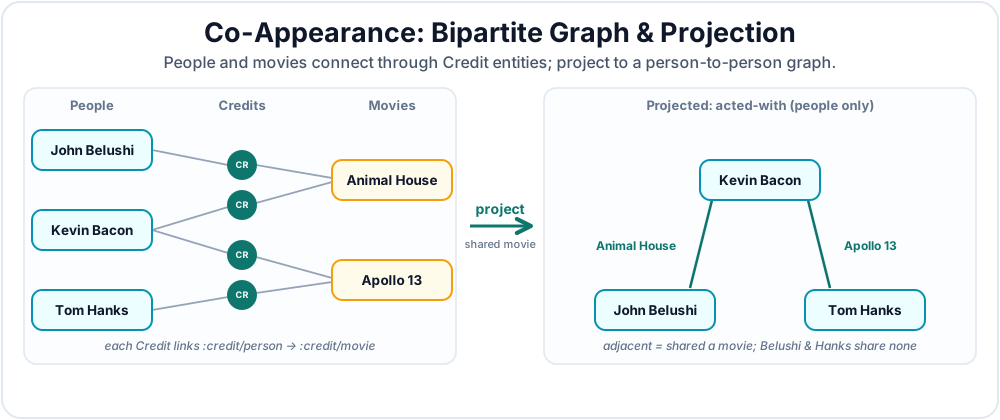
The "six degrees of Kevin Bacon" problem, depicted in Figure 13.3, is a useful graph example because it is not a tree. It is a dense bipartite graph: two kinds of nodes, people and movies, with many connections between the two sets. People connect to movies through credits, and two people are adjacent if they worked on the same movie. Andrew Dennis used this problem to show both Datalog joins and application-level breadth-first search over database facts [3]. The same idea applies naturally to Datalevin.
Model co-appearance through relationship nodes
Model the credit as an entity, not as redundant lists on both actors and movies. The credit is the durable fact that connects a person to a movie and can carry role, billing, source, or time facts later.
(def movie-schema
  {:person/name   {:db/valueType :db.type/string
                   :db/unique    :db.unique/identity}
   :movie/title   {:db/valueType :db.type/string
                   :db/unique    :db.unique/identity}
   :movie/year    {:db/valueType :db.type/long}
   :credit/person {:db/valueType :db.type/ref}
   :credit/movie  {:db/valueType :db.type/ref}
   :credit/role   {:db/valueType :db.type/keyword}})
Schema movieSchema = Datalevin.schema()
    .attr(":person/name", Schema.attribute()
        .valueType(Schema.ValueType.STRING)
        .unique(Schema.Unique.IDENTITY))
    .attr(":movie/title", Schema.attribute()
        .valueType(Schema.ValueType.STRING)
        .unique(Schema.Unique.IDENTITY))
    .attr(":movie/year", Schema.attribute()
        .valueType(Schema.ValueType.LONG))
    .attr(":credit/person", Schema.attribute()
        .valueType(Schema.ValueType.REF))
    .attr(":credit/movie", Schema.attribute()
        .valueType(Schema.ValueType.REF))
    .attr(":credit/role", Schema.attribute()
        .valueType(Schema.ValueType.KEYWORD));
movie_schema = {
    ":person/name": {":db/valueType": ":db.type/string",
                     ":db/unique": ":db.unique/identity"},
    ":movie/title": {":db/valueType": ":db.type/string",
                     ":db/unique": ":db.unique/identity"},
    ":movie/year": {":db/valueType": ":db.type/long"},
    ":credit/person": {":db/valueType": ":db.type/ref"},
    ":credit/movie": {":db/valueType": ":db.type/ref"},
    ":credit/role": {":db/valueType": ":db.type/keyword"}}
const movieSchema = {
  ":person/name": {":db/valueType": ":db.type/string",
                   ":db/unique": ":db.unique/identity"},
  ":movie/title": {":db/valueType": ":db.type/string",
                   ":db/unique": ":db.unique/identity"},
  ":movie/year": {":db/valueType": ":db.type/long"},
  ":credit/person": {":db/valueType": ":db.type/ref"},
  ":credit/movie": {":db/valueType": ":db.type/ref"},
  ":credit/role": {":db/valueType": ":db.type/keyword"}
};
A direct co-appearance query is a join through :credit/movie:
(d/q '[:find ?movie-title
       :in $ ?name-1 ?name-2
       :where
       [?person1-eid :person/name ?name-1]
       [?person2-eid :person/name ?name-2]
       [?credit1-eid :credit/person ?person1-eid]
       [?credit1-eid :credit/movie ?movie-eid]
       [?credit2-eid :credit/person ?person2-eid]
       [?credit2-eid :credit/movie ?movie-eid]
       [(not= ?person1-eid ?person2-eid)]
       [?movie-eid :movie/title ?movie-title]]
     db
     "Kevin Bacon"
     "John Belushi")
Object movies = conn.query(
    "[:find ?movie-title " +
    " :in $ ?name-1 ?name-2 " +
    " :where [?person1-eid :person/name ?name-1] " +
    "        [?person2-eid :person/name ?name-2] " +
    "        [?credit1-eid :credit/person ?person1-eid] " +
    "        [?credit1-eid :credit/movie ?movie-eid] " +
    "        [?credit2-eid :credit/person ?person2-eid] " +
    "        [?credit2-eid :credit/movie ?movie-eid] " +
    "        [(not= ?person1-eid ?person2-eid)] " +
    "        [?movie-eid :movie/title ?movie-title]]",
    "Kevin Bacon",
    "John Belushi");
from datalevin import q

(movie_title, name_1, name_2, person_1, person_2,
 credit_1, credit_2, movie) = map(
    q.var,
    ("movie-title", "name-1", "name-2", "person1-eid", "person2-eid",
     "credit1-eid", "credit2-eid", "movie-eid"),
)
movies = conn.query(q.query(
    find=q.relation(movie_title),
    inputs=[q.DB, name_1, name_2],
    where=[
        q.datom(person_1, "person/name", name_1),
        q.datom(person_2, "person/name", name_2),
        q.datom(credit_1, "credit/person", person_1),
        q.datom(credit_1, "credit/movie", movie),
        q.datom(credit_2, "credit/person", person_2),
        q.datom(credit_2, "credit/movie", movie),
        q.predicate("not=", person_1, person_2),
        q.datom(movie, "movie/title", movie_title),
    ],
), "Kevin Bacon", "John Belushi")
import { q } from "datalevin-node";

const movieTitle = q.var("movie-title");
const name1 = q.var("name-1");
const name2 = q.var("name-2");
const person1 = q.var("person1-eid");
const person2 = q.var("person2-eid");
const credit1 = q.var("credit1-eid");
const credit2 = q.var("credit2-eid");
const movie = q.var("movie-eid");
const movies = await conn.query(q.query({
  find: q.relation(movieTitle),
  inputs: [q.DB, name1, name2],
  where: [
    q.datom(person1, "person/name", name1),
    q.datom(person2, "person/name", name2),
    q.datom(credit1, "credit/person", person1),
    q.datom(credit1, "credit/movie", movie),
    q.datom(credit2, "credit/person", person2),
    q.datom(credit2, "credit/movie", movie),
    q.predicate("not=", person1, person2),
    q.datom(movie, "movie/title", movieTitle)
  ]
}), "Kevin Bacon", "John Belushi");
That answers "Bacon number 1" questions. For a fixed small radius, you can add more joins or generate bounded rules, as shown earlier in this chapter. For an unknown shortest path, use the database to supply neighbors and run a standard graph algorithm in the application. Datalevin makes this practical because the same current database snapshot can be queried repeatedly and refs are indexed.
(defn acted-with
  "Return [other-eid movie-eid] pairs adjacent to actor-eid."
  [db actor-eid]
  (d/q '[:find ?other-eid ?movie-eid
         :in $ ?actor-eid
         :where
         [?credit1-eid :credit/person ?actor-eid]
         [?credit1-eid :credit/movie ?movie-eid]
         [?credit2-eid :credit/movie ?movie-eid]
         [?credit2-eid :credit/person ?other-eid]
         [(not= ?actor-eid ?other-eid)]]
       db actor-eid))

(defn entity-label [db eid]
  (let [m (d/pull db '[:person/name :movie/title] eid)]
    (or (:person/name m)
        (:movie/title m))))

(defn bacon-path
  "Return one shortest alternating [actor movie actor ...] path."
  [db start-name target-name]
  (let [start-eid  (d/q '[:find ?person-eid .
                          :in $ ?name
                          :where [?person-eid :person/name ?name]]
                        db start-name)
        target-eid (d/q '[:find ?person-eid .
                          :in $ ?name
                          :where [?person-eid :person/name ?name]]
                        db target-name)
        edges  (memoize #(acted-with db %))]
    (loop [queue (conj clojure.lang.PersistentQueue/EMPTY [start-eid])
           seen  #{start-eid}]
      (when-let [path (peek queue)]
        (let [actor-eid (peek path)]
          (if (= actor-eid target-eid)
            (mapv (partial entity-label db) path)
            (let [next-edges (remove #(seen (first %)) (edges actor-eid))]
              (recur
                (into (pop queue)
                      (map (fn [[other-eid movie-eid]]
                             (conj path movie-eid other-eid))
                           next-edges))
                (into seen (map first next-edges))))))))))
record CreditEdge(Object otherEid, Object movieEid) {}

static List<CreditEdge> actedWith(Connection conn, Object actorEid) {
    List<?> rows = (List<?>) conn.query(
        "[:find ?other-eid ?movie-eid " +
        " :in $ ?actor-eid " +
        " :where [?credit1-eid :credit/person ?actor-eid] " +
        "        [?credit1-eid :credit/movie ?movie-eid] " +
        "        [?credit2-eid :credit/movie ?movie-eid] " +
        "        [?credit2-eid :credit/person ?other-eid] " +
        "        [(not= ?actor-eid ?other-eid)]]",
        actorEid);
    return rows.stream()
        .map(row -> (List<?>) row)
        .map(row -> new CreditEdge(row.get(0), row.get(1)))
        .toList();
}

static String entityLabel(Connection conn, Object eid) {
    Map<?, ?> entity = conn.pull("[:person/name :movie/title]", eid);
    Object person = entity.get(Datalevin.kw(":person/name"));
    Object movie = entity.get(Datalevin.kw(":movie/title"));
    return String.valueOf(person != null ? person : movie);
}

static List<String> baconPath(Connection conn,
                              String startName,
                              String targetName) {
    Object startEid = conn.query(
        "[:find ?person-eid . :in $ ?name :where [?person-eid :person/name ?name]]",
        startName);
    Object targetEid = conn.query(
        "[:find ?person-eid . :in $ ?name :where [?person-eid :person/name ?name]]",
        targetName);

    Queue<List<Object>> queue = new ArrayDeque<>();
    Set<Object> seen = new HashSet<>();
    queue.add(List.of(startEid));
    seen.add(startEid);

    while (!queue.isEmpty()) {
        List<Object> path = queue.remove();
        Object actorEid = path.get(path.size() - 1);
        if (actorEid.equals(targetEid)) {
            return path.stream()
                .map(eid -> entityLabel(conn, eid))
                .toList();
        }
        for (CreditEdge edge : actedWith(conn, actorEid)) {
            if (seen.add(edge.otherEid())) {
                ArrayList<Object> next = new ArrayList<>(path);
                next.add(edge.movieEid());
                next.add(edge.otherEid());
                queue.add(next);
            }
        }
    }
    return List.of();
}
from collections import deque
from datalevin import q

actor, other, movie, credit_1, credit_2 = map(
    q.var,
    ("actor-eid", "other-eid", "movie-eid", "credit1-eid", "credit2-eid"),
)
acted_with_query = q.query(
    find=q.relation(other, movie),
    inputs=[q.DB, actor],
    where=[
        q.datom(credit_1, "credit/person", actor),
        q.datom(credit_1, "credit/movie", movie),
        q.datom(credit_2, "credit/movie", movie),
        q.datom(credit_2, "credit/person", other),
        q.predicate("not=", actor, other),
    ],
)

person, name = map(q.var, ("person-eid", "name"))
person_by_name_query = q.query(
    find=q.scalar(person),
    inputs=[q.DB, name],
    where=[q.datom(person, "person/name", name)],
)
label_selector = q.selector("person/name", "movie/title")

def acted_with(conn, actor_eid):
    return conn.query(acted_with_query, actor_eid)

def entity_label(conn, eid):
    entity = conn.pull(label_selector, eid)
    return entity.get(":person/name") or entity.get(":movie/title")

def bacon_path(conn, start_name, target_name):
    start_eid = conn.query(person_by_name_query, start_name)
    target_eid = conn.query(person_by_name_query, target_name)

    queue = deque([[start_eid]])
    seen = {start_eid}

    while queue:
        path = queue.popleft()
        actor_eid = path[-1]
        if actor_eid == target_eid:
            return [entity_label(conn, eid) for eid in path]
        for other_eid, movie_eid in acted_with(conn, actor_eid):
            if other_eid not in seen:
                seen.add(other_eid)
                queue.append([*path, movie_eid, other_eid])
    return []
import { q } from "datalevin-node";

const actor = q.var("actor-eid");
const other = q.var("other-eid");
const movie = q.var("movie-eid");
const credit1 = q.var("credit1-eid");
const credit2 = q.var("credit2-eid");
const actedWithQuery = q.query({
  find: q.relation(other, movie),
  inputs: [q.DB, actor],
  where: [
    q.datom(credit1, "credit/person", actor),
    q.datom(credit1, "credit/movie", movie),
    q.datom(credit2, "credit/movie", movie),
    q.datom(credit2, "credit/person", other),
    q.predicate("not=", actor, other)
  ]
});

const person = q.var("person-eid");
const name = q.var("name");
const personByNameQuery = q.query({
  find: q.scalar(person),
  inputs: [q.DB, name],
  where: [q.datom(person, "person/name", name)]
});
const labelSelector = q.selector("person/name", "movie/title");

async function actedWith(conn, actorEid) {
  return await conn.query(actedWithQuery, actorEid);
}

async function entityLabel(conn, eid) {
  const entity = await conn.pull(labelSelector, eid);
  return entity[":person/name"] ?? entity[":movie/title"];
}

async function baconPath(conn, startName, targetName) {
  const startEid = await conn.query(personByNameQuery, startName);
  const targetEid = await conn.query(personByNameQuery, targetName);

  const queue = [[startEid]];
  const seen = new Set([startEid]);

  while (queue.length > 0) {
    const path = queue.shift();
    const actorEid = path[path.length - 1];
    if (actorEid === targetEid) {
      return await Promise.all(path.map((eid) => entityLabel(conn, eid)));
    }
    for (const [otherEid, movieEid] of await actedWith(conn, actorEid)) {
      if (!seen.has(otherEid)) {
        seen.add(otherEid);
        queue.push([...path, movieEid, otherEid]);
      }
    }
  }
  return [];
}
Listing 13.2 treats Datalevin as the graph store and keeps shortest-path policy in ordinary code. That is often a practical split: use Datalog for the local neighborhood relation, and use a graph algorithm when the query needs a global search strategy.
4.2 Dependency and Impact Analysis
Package managers, build systems, data pipelines, and microservice deployments often need the reverse of a dependency graph question. If core changes, what must be rebuilt? If a table changes, which reports are affected?
Model each dependency as an edge from the dependent item to the thing it uses:
{:component/name {:db/valueType :db.type/string
                  :db/unique    :db.unique/identity}
 :component/uses {:db/valueType :db.type/ref}}
Schema componentSchema = Datalevin.schema()
    .attr(":component/name", Schema.attribute()
        .valueType(Schema.ValueType.STRING)
        .unique(Schema.Unique.IDENTITY))
    .attr(":component/uses", Schema.attribute()
        .valueType(Schema.ValueType.REF));
component_schema = {
    ":component/name": {":db/valueType": ":db.type/string",
                        ":db/unique": ":db.unique/identity"},
    ":component/uses": {":db/valueType": ":db.type/ref"}}
const componentSchema = {
  ":component/name": {":db/valueType": ":db.type/string",
                      ":db/unique": ":db.unique/identity"},
  ":component/uses": {":db/valueType": ":db.type/ref"}
};
Then define reachability over :component/uses:
(def dependency-rules
  '[[(depends-on ?component-eid ?dependency-eid)
     [?component-eid :component/uses ?dependency-eid]]

    [(depends-on ?component-eid ?dependency-eid)
     [?component-eid :component/uses ?direct-eid]
     (depends-on ?direct-eid ?dependency-eid)]])
Object dependencyRules = Datalevin.edn(
    "[[(depends-on ?component-eid ?dependency-eid) " +
    "  [?component-eid :component/uses ?dependency-eid]] " +
    " [(depends-on ?component-eid ?dependency-eid) " +
    "  [?component-eid :component/uses ?direct-eid] " +
    "  (depends-on ?direct-eid ?dependency-eid)]]");
component = q.var("component-eid")
dependency = q.var("dependency-eid")
direct = q.var("direct-eid")
dependency_args = q.join_vars(component, dependency)
dependency_rules = q.rules(
    q.rule_branch(
        "depends-on", dependency_args,
        q.datom(component, "component/uses", dependency),
    ),
    q.rule_branch(
        "depends-on", dependency_args,
        q.datom(component, "component/uses", direct),
        q.rule("depends-on", direct, dependency),
    ),
)
const component = q.var("component-eid");
const dependency = q.var("dependency-eid");
const direct = q.var("direct-eid");
const dependencyArgs = q.joinVars(component, dependency);
const dependencyRules = q.rules(
  q.ruleBranch(
    "depends-on", dependencyArgs,
    q.datom(component, "component/uses", dependency)
  ),
  q.ruleBranch(
    "depends-on", dependencyArgs,
    q.datom(component, "component/uses", direct),
    q.rule("depends-on", direct, dependency)
  )
);
To find everything impacted by a changed component, bind the dependency side and ask which components depend on it:
(d/q '[:find ?impacted-name
       :in $ % ?changed-name
       :where
       [?changed-eid :component/name ?changed-name]
       (depends-on ?impacted-eid ?changed-eid)
       [?impacted-eid :component/name ?impacted-name]]
     db dependency-rules "core")
Object impacted = conn.query(
    "[:find ?impacted-name " +
    " :in $ % ?changed-name " +
    " :where [?changed-eid :component/name ?changed-name] " +
    "        (depends-on ?impacted-eid ?changed-eid) " +
    "        [?impacted-eid :component/name ?impacted-name]]",
    dependencyRules,
    "core");
changed = q.var("changed-eid")
impacted_eid = q.var("impacted-eid")
changed_name = q.var("changed-name")
impacted_name = q.var("impacted-name")
impacted = conn.query(q.query(
    find=q.relation(impacted_name),
    inputs=[q.DB, q.RULES, changed_name],
    where=[
        q.datom(changed, "component/name", changed_name),
        q.rule("depends-on", impacted_eid, changed),
        q.datom(impacted_eid, "component/name", impacted_name),
    ],
), dependency_rules, "core")
const changed = q.var("changed-eid");
const impactedEid = q.var("impacted-eid");
const changedName = q.var("changed-name");
const impactedName = q.var("impacted-name");
const impacted = await conn.query(q.query({
  find: q.relation(impactedName),
  inputs: [q.DB, q.RULES, changedName],
  where: [
    q.datom(changed, "component/name", changedName),
    q.rule("depends-on", impactedEid, changed),
    q.datom(impactedEid, "component/name", impactedName)
  ]
}), dependencyRules, "core");
The same pattern works for "which policies inherit this rule?", "which dashboards read from this dataset?", and "which generated files depend on this source file?"
4.3 Weighted Paths and Route Search
Some graph questions are about reachability; others are about optimal paths. Route planning, network latency, risk propagation, and cost-based dependency planning all attach weights to edges.
Model a weighted edge as an entity:
{:route/from {:db/valueType :db.type/ref}
 :route/to   {:db/valueType :db.type/ref}
 :route/km   {:db/valueType :db.type/double}}
Schema routeSchema = Datalevin.schema()
    .attr(":route/from", Schema.attribute()
        .valueType(Schema.ValueType.REF))
    .attr(":route/to", Schema.attribute()
        .valueType(Schema.ValueType.REF))
    .attr(":route/km", Schema.attribute()
        .valueType(Schema.ValueType.DOUBLE));
route_schema = {
    ":route/from": {":db/valueType": ":db.type/ref"},
    ":route/to": {":db/valueType": ":db.type/ref"},
    ":route/km": {":db/valueType": ":db.type/double"}}
const routeSchema = {
  ":route/from": {":db/valueType": ":db.type/ref"},
  ":route/to": {":db/valueType": ":db.type/ref"},
  ":route/km": {":db/valueType": ":db.type/double"}
};
Datalog can enumerate bounded path shapes and sum their weights when the bound is small:
(d/q '[:find ?mid-name ?km
       :in $ ?from-name ?to-name
       :where
       [?from-eid :place/name ?from-name]
       [?to-eid :place/name ?to-name]
       [?route1-eid :route/from ?from-eid]
       [?route1-eid :route/to ?mid-eid]
       [?route1-eid :route/km ?km1]
       [?route2-eid :route/from ?mid-eid]
       [?route2-eid :route/to ?to-eid]
       [?route2-eid :route/km ?km2]
       [(+ ?km1 ?km2) ?km]
       [?mid-eid :place/name ?mid-name]]
     db "Paris" "Berlin")
Object routes = conn.query(
    "[:find ?mid-name ?km " +
    " :in $ ?from-name ?to-name " +
    " :where [?from-eid :place/name ?from-name] " +
    "        [?to-eid :place/name ?to-name] " +
    "        [?route1-eid :route/from ?from-eid] " +
    "        [?route1-eid :route/to ?mid-eid] " +
    "        [?route1-eid :route/km ?km1] " +
    "        [?route2-eid :route/from ?mid-eid] " +
    "        [?route2-eid :route/to ?to-eid] " +
    "        [?route2-eid :route/km ?km2] " +
    "        [(+ ?km1 ?km2) ?km] " +
    "        [?mid-eid :place/name ?mid-name]]",
    "Paris",
    "Berlin");
from datalevin import q

(middle_name, total_km, from_name, to_name, from_place, to_place,
 route_1, route_2, middle, km_1, km_2) = map(
    q.var,
    ("mid-name", "km", "from-name", "to-name", "from-eid", "to-eid",
     "route1-eid", "route2-eid", "mid-eid", "km1", "km2"),
)
routes = conn.query(q.query(
    find=q.relation(middle_name, total_km),
    inputs=[q.DB, from_name, to_name],
    where=[
        q.datom(from_place, "place/name", from_name),
        q.datom(to_place, "place/name", to_name),
        q.datom(route_1, "route/from", from_place),
        q.datom(route_1, "route/to", middle),
        q.datom(route_1, "route/km", km_1),
        q.datom(route_2, "route/from", middle),
        q.datom(route_2, "route/to", to_place),
        q.datom(route_2, "route/km", km_2),
        q.bind("+", total_km, km_1, km_2),
        q.datom(middle, "place/name", middle_name),
    ],
), "Paris", "Berlin")
import { q } from "datalevin-node";

const middleName = q.var("mid-name");
const totalKm = q.var("km");
const fromName = q.var("from-name");
const toName = q.var("to-name");
const fromPlace = q.var("from-eid");
const toPlace = q.var("to-eid");
const route1 = q.var("route1-eid");
const route2 = q.var("route2-eid");
const middle = q.var("mid-eid");
const km1 = q.var("km1");
const km2 = q.var("km2");
const routes = await conn.query(q.query({
  find: q.relation(middleName, totalKm),
  inputs: [q.DB, fromName, toName],
  where: [
    q.datom(fromPlace, "place/name", fromName),
    q.datom(toPlace, "place/name", toName),
    q.datom(route1, "route/from", fromPlace),
    q.datom(route1, "route/to", middle),
    q.datom(route1, "route/km", km1),
    q.datom(route2, "route/from", middle),
    q.datom(route2, "route/to", toPlace),
    q.datom(route2, "route/km", km2),
    q.bind("+", totalKm, km1, km2),
    q.datom(middle, "place/name", middleName)
  ]
}), "Paris", "Berlin");
Use algorithms for global path search
For unbounded weighted shortest path, use Dijkstra, A*, or another application algorithm. Let Datalevin answer the indexed neighbor query, but let the algorithm own the priority queue and stopping condition. That keeps the database model clear and avoids forcing every graph algorithm into one Datalog query.
4.4 Lineage Through Relationship Nodes
Some graphs are not stored as one obvious edge. For example, doctoral student advisor lineage is traced through dissertations: a person advises a dissertation, and the dissertation points to the student who authored it [4]. The logical edge "advisor advised student" is therefore a derived relation, not a stored attribute.
{:person/name        {:db/valueType :db.type/string}
 :person/advised     {:db/valueType   :db.type/ref
                      :db/cardinality :db.cardinality/many}
 :dissertation/cid   {:db/valueType :db.type/ref}
 :dissertation/univ  {:db/valueType :db.type/string}
 :dissertation/area  {:db/valueType :db.type/string}
 :dissertation/title {:db/valueType :db.type/string}}
Schema academicSchema = Datalevin.schema()
    .attr(":person/name", Schema.attribute()
        .valueType(Schema.ValueType.STRING))
    .attr(":person/advised", Schema.attribute()
        .valueType(Schema.ValueType.REF)
        .cardinality(Schema.Cardinality.MANY))
    .attr(":dissertation/cid", Schema.attribute()
        .valueType(Schema.ValueType.REF))
    .attr(":dissertation/univ", Schema.attribute()
        .valueType(Schema.ValueType.STRING))
    .attr(":dissertation/area", Schema.attribute()
        .valueType(Schema.ValueType.STRING))
    .attr(":dissertation/title", Schema.attribute()
        .valueType(Schema.ValueType.STRING));
academic_schema = {
    ":person/name": {":db/valueType": ":db.type/string"},
    ":person/advised": {":db/valueType": ":db.type/ref",
                        ":db/cardinality": ":db.cardinality/many"},
    ":dissertation/cid": {":db/valueType": ":db.type/ref"},
    ":dissertation/univ": {":db/valueType": ":db.type/string"},
    ":dissertation/area": {":db/valueType": ":db.type/string"},
    ":dissertation/title": {":db/valueType": ":db.type/string"}}
const academicSchema = {
  ":person/name": {":db/valueType": ":db.type/string"},
  ":person/advised": {":db/valueType": ":db.type/ref",
                      ":db/cardinality": ":db.cardinality/many"},
  ":dissertation/cid": {":db/valueType": ":db.type/ref"},
  ":dissertation/univ": {":db/valueType": ":db.type/string"},
  ":dissertation/area": {":db/valueType": ":db.type/string"},
  ":dissertation/title": {":db/valueType": ":db.type/string"}
};
Rules give names to the useful graph relations:
(def academic-rules
  '[[(author ?dissertation-eid ?person-eid)
     [?dissertation-eid :dissertation/cid ?person-eid]]

    [(advised ?advisor-eid ?student-eid)
     [?advisor-eid :person/advised ?dissertation-eid]
     (author ?dissertation-eid ?student-eid)]

    [(academic-ancestor ?ancestor-eid ?student-eid)
     (advised ?ancestor-eid ?student-eid)]

    [(academic-ancestor ?ancestor-eid ?student-eid)
     (advised ?ancestor-eid ?middle-eid)
     (academic-ancestor ?middle-eid ?student-eid)]])
Object academicRules = Datalevin.edn(
    "[[(author ?dissertation-eid ?person-eid) " +
    "  [?dissertation-eid :dissertation/cid ?person-eid]] " +
    " [(advised ?advisor-eid ?student-eid) " +
    "  [?advisor-eid :person/advised ?dissertation-eid] " +
    "  (author ?dissertation-eid ?student-eid)] " +
    " [(academic-ancestor ?ancestor-eid ?student-eid) " +
    "  (advised ?ancestor-eid ?student-eid)] " +
    " [(academic-ancestor ?ancestor-eid ?student-eid) " +
    "  (advised ?ancestor-eid ?middle-eid) " +
    "  (academic-ancestor ?middle-eid ?student-eid)]]");
dissertation = q.var("dissertation-eid")
person = q.var("person-eid")
advisor = q.var("advisor-eid")
student = q.var("student-eid")
ancestor = q.var("ancestor-eid")
middle = q.var("middle-eid")

academic_rules = q.rules(
    q.rule_branch(
        "author", q.join_vars(dissertation, person),
        q.datom(dissertation, "dissertation/cid", person),
    ),
    q.rule_branch(
        "advised", q.join_vars(advisor, student),
        q.datom(advisor, "person/advised", dissertation),
        q.rule("author", dissertation, student),
    ),
    q.rule_branch(
        "academic-ancestor", q.join_vars(ancestor, student),
        q.rule("advised", ancestor, student),
    ),
    q.rule_branch(
        "academic-ancestor", q.join_vars(ancestor, student),
        q.rule("advised", ancestor, middle),
        q.rule("academic-ancestor", middle, student),
    ),
)
const dissertation = q.var("dissertation-eid");
const person = q.var("person-eid");
const advisor = q.var("advisor-eid");
const student = q.var("student-eid");
const ancestor = q.var("ancestor-eid");
const middle = q.var("middle-eid");

const academicRules = q.rules(
  q.ruleBranch(
    "author", q.joinVars(dissertation, person),
    q.datom(dissertation, "dissertation/cid", person)
  ),
  q.ruleBranch(
    "advised", q.joinVars(advisor, student),
    q.datom(advisor, "person/advised", dissertation),
    q.rule("author", dissertation, student)
  ),
  q.ruleBranch(
    "academic-ancestor", q.joinVars(ancestor, student),
    q.rule("advised", ancestor, student)
  ),
  q.ruleBranch(
    "academic-ancestor", q.joinVars(ancestor, student),
    q.rule("advised", ancestor, middle),
    q.rule("academic-ancestor", middle, student)
  )
);
Now "find all academic ancestors of a person" is a graph traversal over a relation that was assembled from several attributes:
(d/q '[:find ?ancestor-name
       :in $ % ?student-name
       :where
       [?student-eid :person/name ?student-name]
       (academic-ancestor ?ancestor-eid ?student-eid)
       [?ancestor-eid :person/name ?ancestor-name]]
     db academic-rules "David Scott Warren")
Object ancestors = conn.query(
    "[:find ?ancestor-name " +
    " :in $ % ?student-name " +
    " :where [?student-eid :person/name ?student-name] " +
    "        (academic-ancestor ?ancestor-eid ?student-eid) " +
    "        [?ancestor-eid :person/name ?ancestor-name]]",
    academicRules,
    "David Scott Warren");
student_name = q.var("student-name")
ancestor_name = q.var("ancestor-name")
ancestors = conn.query(q.query(
    find=q.relation(ancestor_name),
    inputs=[q.DB, q.RULES, student_name],
    where=[
        q.datom(student, "person/name", student_name),
        q.rule("academic-ancestor", ancestor, student),
        q.datom(ancestor, "person/name", ancestor_name),
    ],
), academic_rules, "David Scott Warren")
const studentName = q.var("student-name");
const ancestorName = q.var("ancestor-name");
const ancestors = await conn.query(q.query({
  find: q.relation(ancestorName),
  inputs: [q.DB, q.RULES, studentName],
  where: [
    q.datom(student, "person/name", studentName),
    q.rule("academic-ancestor", ancestor, student),
    q.datom(ancestor, "person/name", ancestorName)
  ]
}), academicRules, "David Scott Warren");
This is a good pattern when the edge has a first-class domain object behind it. The dissertation is not merely a join artifact; it has title, institution, area, and year facts of its own. Keeping that node visible preserves domain meaning while rules recover the convenient graph relation.
4.5 Type Graphs and Class Derivation
Graph reasoning is not limited to social links or dependency chains. In some cases, entities have concrete :type facts, and rules derive membership in broader classes such as :Student, :Faculty, and :Person [5].
The attributes in this section and the next follow the compact OpenRuleBench/LUBM-style benchmark schemas, so they use names such as :type, :advisor, :par, and :sib. In application schemas, prefer the namespacing convention from Chapter 5, for example :university/type, :student/advisor, :person/parent, or :person/sibling.
(def university-type-rules
  '[[(is-a ?x-eid ?class)
     [?x-eid :type :GraduateStudent]
     [(ground :Student) ?class]]
    [(is-a ?x-eid ?class)
     [?x-eid :type :UndergraduateStudent]
     [(ground :Student) ?class]]
    [(is-a ?x-eid ?class)
     (is-a ?x-eid ?student-class)
     [(= ?student-class :Student)]
     [(ground :Person) ?class]]

    [(is-a ?x-eid ?class)
     [?x-eid :type :FullProfessor]
     [(ground :Professor) ?class]]
    [(is-a ?x-eid ?class)
     [?x-eid :type :AssociateProfessor]
     [(ground :Professor) ?class]]
    [(is-a ?x-eid ?class)
     (is-a ?x-eid ?professor-class)
     [(= ?professor-class :Professor)]
     [(ground :Faculty) ?class]]
    [(is-a ?x-eid ?class)
     (is-a ?x-eid ?faculty-class)
     [(= ?faculty-class :Faculty)]
     [(ground :Person) ?class]]])
Object universityTypeRules = Datalevin.edn(
    "[[(is-a ?x-eid ?class) " +
    "  [?x-eid :type :GraduateStudent] " +
    "  [(ground :Student) ?class]] " +
    " [(is-a ?x-eid ?class) " +
    "  [?x-eid :type :UndergraduateStudent] " +
    "  [(ground :Student) ?class]] " +
    " [(is-a ?x-eid ?class) " +
    "  (is-a ?x-eid ?student-class) " +
    "  [(= ?student-class :Student)] " +
    "  [(ground :Person) ?class]] " +
    " [(is-a ?x-eid ?class) " +
    "  [?x-eid :type :FullProfessor] " +
    "  [(ground :Professor) ?class]] " +
    " [(is-a ?x-eid ?class) " +
    "  [?x-eid :type :AssociateProfessor] " +
    "  [(ground :Professor) ?class]] " +
    " [(is-a ?x-eid ?class) " +
    "  (is-a ?x-eid ?professor-class) " +
    "  [(= ?professor-class :Professor)] " +
    "  [(ground :Faculty) ?class]] " +
    " [(is-a ?x-eid ?class) " +
    "  (is-a ?x-eid ?faculty-class) " +
    "  [(= ?faculty-class :Faculty)] " +
    "  [(ground :Person) ?class]]]");
x_eid = q.var("x-eid")
class_ = q.var("class")
student_class = q.var("student-class")
professor_class = q.var("professor-class")
faculty_class = q.var("faculty-class")
type_args = q.join_vars(x_eid, class_)


def concrete_type_rule(stored_type, derived_type):
    return q.rule_branch(
        "is-a", type_args,
        q.datom(x_eid, "type", q.kw(stored_type)),
        q.bind("ground", class_, q.kw(derived_type)),
    )


university_type_rules = q.rules(
    concrete_type_rule("GraduateStudent", "Student"),
    concrete_type_rule("UndergraduateStudent", "Student"),
    q.rule_branch(
        "is-a", type_args,
        q.rule("is-a", x_eid, student_class),
        q.predicate("=", student_class, q.kw("Student")),
        q.bind("ground", class_, q.kw("Person")),
    ),
    concrete_type_rule("FullProfessor", "Professor"),
    concrete_type_rule("AssociateProfessor", "Professor"),
    q.rule_branch(
        "is-a", type_args,
        q.rule("is-a", x_eid, professor_class),
        q.predicate("=", professor_class, q.kw("Professor")),
        q.bind("ground", class_, q.kw("Faculty")),
    ),
    q.rule_branch(
        "is-a", type_args,
        q.rule("is-a", x_eid, faculty_class),
        q.predicate("=", faculty_class, q.kw("Faculty")),
        q.bind("ground", class_, q.kw("Person")),
    ),
)
const xEid = q.var("x-eid");
const classValue = q.var("class");
const studentClass = q.var("student-class");
const professorClass = q.var("professor-class");
const facultyClass = q.var("faculty-class");
const typeArgs = q.joinVars(xEid, classValue);

const concreteTypeRule = (storedType, derivedType) => q.ruleBranch(
  "is-a", typeArgs,
  q.datom(xEid, "type", q.kw(storedType)),
  q.bind("ground", classValue, q.kw(derivedType))
);

const universityTypeRules = q.rules(
  concreteTypeRule("GraduateStudent", "Student"),
  concreteTypeRule("UndergraduateStudent", "Student"),
  q.ruleBranch(
    "is-a", typeArgs,
    q.rule("is-a", xEid, studentClass),
    q.predicate("=", studentClass, q.kw("Student")),
    q.bind("ground", classValue, q.kw("Person"))
  ),
  concreteTypeRule("FullProfessor", "Professor"),
  concreteTypeRule("AssociateProfessor", "Professor"),
  q.ruleBranch(
    "is-a", typeArgs,
    q.rule("is-a", xEid, professorClass),
    q.predicate("=", professorClass, q.kw("Professor")),
    q.bind("ground", classValue, q.kw("Faculty"))
  ),
  q.ruleBranch(
    "is-a", typeArgs,
    q.rule("is-a", xEid, facultyClass),
    q.predicate("=", facultyClass, q.kw("Faculty")),
    q.bind("ground", classValue, q.kw("Person"))
  )
);
A query can then ask at the semantic level it cares about:
(d/q '[:find ?student-eid ?advisor-eid
       :in $ %
       :where
       (is-a ?student-eid ?class)
       [(= ?class :Student)]
       [?student-eid :advisor ?advisor-eid]]
     db university-type-rules)
Object advisors = conn.query(
    "[:find ?student-eid ?advisor-eid " +
    " :in $ % " +
    " :where (is-a ?student-eid ?class) " +
    "        [(= ?class :Student)] " +
    "        [?student-eid :advisor ?advisor-eid]]",
    universityTypeRules);
student_eid = q.var("student-eid")
advisor_eid = q.var("advisor-eid")
advisors = conn.query(q.query(
    find=q.relation(student_eid, advisor_eid),
    inputs=[q.DB, q.RULES],
    where=[
        q.rule("is-a", student_eid, class_),
        q.predicate("=", class_, q.kw("Student")),
        q.datom(student_eid, "advisor", advisor_eid),
    ],
), university_type_rules)
const studentEid = q.var("student-eid");
const advisorEid = q.var("advisor-eid");
const advisors = await conn.query(q.query({
  find: q.relation(studentEid, advisorEid),
  inputs: [q.DB, q.RULES],
  where: [
    q.rule("is-a", studentEid, classValue),
    q.predicate("=", classValue, q.kw("Student")),
    q.datom(studentEid, "advisor", advisorEid)
  ]
}), universityTypeRules);
This does not require Datalevin attributes themselves to become an ontology. The class graph is ordinary application data, and the rules describe how that application wants to interpret it.
4.6 Same-Generation Relations
A second OpenRuleBench-style derived relation is same generation over :par and :sib base relations. This is different from reachability: it derives a relation between pairs of nodes that occupy the same structural level.
(def same-generation-rules
  '[[(same-generation ?x-eid ?y-eid)
     [?x-eid :sib ?y-eid]]
    [(same-generation ?x-eid ?y-eid)
     [?x-eid :par ?z-eid]
     (same-generation ?z-eid ?z1-eid)
     [?y-eid :par ?z1-eid]]])
Object sameGenerationRules = Datalevin.edn(
    "[[(same-generation ?x-eid ?y-eid) " +
    "  [?x-eid :sib ?y-eid]] " +
    " [(same-generation ?x-eid ?y-eid) " +
    "  [?x-eid :par ?z-eid] " +
    "  (same-generation ?z-eid ?z1-eid) " +
    "  [?y-eid :par ?z1-eid]]]");
x_eid = q.var("x-eid")
y_eid = q.var("y-eid")
z_eid = q.var("z-eid")
z1_eid = q.var("z1-eid")
generation_args = q.join_vars(x_eid, y_eid)
same_generation_rules = q.rules(
    q.rule_branch(
        "same-generation", generation_args,
        q.datom(x_eid, "sib", y_eid),
    ),
    q.rule_branch(
        "same-generation", generation_args,
        q.datom(x_eid, "par", z_eid),
        q.rule("same-generation", z_eid, z1_eid),
        q.datom(y_eid, "par", z1_eid),
    ),
)
const xEid = q.var("x-eid");
const yEid = q.var("y-eid");
const zEid = q.var("z-eid");
const z1Eid = q.var("z1-eid");
const generationArgs = q.joinVars(xEid, yEid);
const sameGenerationRules = q.rules(
  q.ruleBranch(
    "same-generation", generationArgs,
    q.datom(xEid, "sib", yEid)
  ),
  q.ruleBranch(
    "same-generation", generationArgs,
    q.datom(xEid, "par", zEid),
    q.rule("same-generation", zEid, z1Eid),
    q.datom(yEid, "par", z1Eid)
  )
);
The base case says that sibling pairs are same-generation. The recursive case says that if ?x-eid has a :par edge to ?z-eid, ?y-eid has a :par edge to ?z1-eid, and ?z-eid and ?z1-eid are same-generation, then ?x-eid and ?y-eid are same-generation. This kind of query is useful for structural comparisons, lineage analysis, and rule-engine tests because the derived relation is about two moving positions in the graph, not one source-to-target path.
5. Example: Finding the Forum for a Message (LDBC SNB IS6)
The LDBC Social Network Benchmark (LDBC SNB) is an industry standard for evaluating graph databases. It models a social network with people, friendships, forums, posts, comments, likes, tags, organizations, and places [6]. This section examines one real Interactive Short query from the benchmark to show graph traversal in practice.
Query IS6: Given a message, find the forum that contains it and the person who moderates that forum. Because comments are not directly contained in forums, the query traverses to the original post in the thread.
Define a recursive rule to find the root post of any message:
(def root-post-rule
  '[;; base case
    [(root-post ?message-eid ?post-eid)
     [?message-eid :message/isContainedIn _]
     [(ground ?message-eid) ?post-eid]] ; copy the root message eid into ?post-eid

    ;; recursive case
    [(root-post ?message-eid ?post-eid)
     [?message-eid :message/replyOf ?parent-eid]
     (root-post ?parent-eid ?post-eid)]])
Object rootPostRule = Datalevin.edn(
    "[[(root-post ?message-eid ?post-eid) " +
    "  [?message-eid :message/isContainedIn _] " +
    "  [(ground ?message-eid) ?post-eid]] " +
    " [(root-post ?message-eid ?post-eid) " +
    "  [?message-eid :message/replyOf ?parent-eid] " +
    "  (root-post ?parent-eid ?post-eid)]]");
message_eid = q.var("message-eid")
post_eid = q.var("post-eid")
parent_eid = q.var("parent-eid")
root_post_args = q.join_vars(message_eid, post_eid)
root_post_rule = q.rules(
    q.rule_branch(
        "root-post", root_post_args,
        q.datom(message_eid, "message/isContainedIn", q.IGNORE),
        q.bind("ground", post_eid, message_eid),
    ),
    q.rule_branch(
        "root-post", root_post_args,
        q.datom(message_eid, "message/replyOf", parent_eid),
        q.rule("root-post", parent_eid, post_eid),
    ),
)
const messageEid = q.var("message-eid");
const postEid = q.var("post-eid");
const parentEid = q.var("parent-eid");
const rootPostArgs = q.joinVars(messageEid, postEid);
const rootPostRule = q.rules(
  q.ruleBranch(
    "root-post", rootPostArgs,
    q.datom(messageEid, "message/isContainedIn", q.IGNORE),
    q.bind("ground", postEid, messageEid)
  ),
  q.ruleBranch(
    "root-post", rootPostArgs,
    q.datom(messageEid, "message/replyOf", parentEid),
    q.rule("root-post", parentEid, postEid)
  )
);
The rule has two branches:
- If the message has
:message/isContainedIn, it is itself the root post. - Otherwise, follow
:message/replyOfrecursively until the query reaches the root.
Now the query to find the forum and moderator:
(d/q '[:find ?forum-id ?forum-title ?moderator-id
              ?moderator-first-name ?moderator-last-name
       :in $ % ?message-id            ; $=db, %=rules, ?message-id=input
       :where
       ;; locate the message
       [?message-eid :message/id ?message-id]

       ;; traverse to root post (recursive rule)
       (root-post ?message-eid ?post-eid)

       ;; get forum containing the post
       [?post-eid :message/isContainedIn ?forum-eid]
       [?forum-eid :forum/id ?forum-id]
       [?forum-eid :forum/title ?forum-title]

       ;; get forum moderator
       [?forum-eid :forum/hasModerator ?moderator-eid]
       [?moderator-eid :person/id ?moderator-id]
       [?moderator-eid :person/firstName ?moderator-first-name]
       [?moderator-eid :person/lastName ?moderator-last-name]]
     db root-post-rule message-id)
Object forum = conn.query(
    "[:find ?forum-id ?forum-title ?moderator-id " +
    "       ?moderator-first-name ?moderator-last-name " +
    " :in $ % ?message-id " +
    " :where [?message-eid :message/id ?message-id] " +
    "        (root-post ?message-eid ?post-eid) " +
    "        [?post-eid :message/isContainedIn ?forum-eid] " +
    "        [?forum-eid :forum/id ?forum-id] " +
    "        [?forum-eid :forum/title ?forum-title] " +
    "        [?forum-eid :forum/hasModerator ?moderator-eid] " +
    "        [?moderator-eid :person/id ?moderator-id] " +
    "        [?moderator-eid :person/firstName ?moderator-first-name] " +
    "        [?moderator-eid :person/lastName ?moderator-last-name]]",
    rootPostRule,
    messageId);
message_id_input = q.var("message-id")
forum_eid = q.var("forum-eid")
forum_id = q.var("forum-id")
forum_title = q.var("forum-title")
moderator_eid = q.var("moderator-eid")
moderator_id = q.var("moderator-id")
moderator_first = q.var("moderator-first-name")
moderator_last = q.var("moderator-last-name")

forum = conn.query(q.query(
    find=q.relation(
        forum_id, forum_title, moderator_id, moderator_first, moderator_last
    ),
    inputs=[q.DB, q.RULES, message_id_input],
    where=[
        q.datom(message_eid, "message/id", message_id_input),
        q.rule("root-post", message_eid, post_eid),
        q.datom(post_eid, "message/isContainedIn", forum_eid),
        q.datom(forum_eid, "forum/id", forum_id),
        q.datom(forum_eid, "forum/title", forum_title),
        q.datom(forum_eid, "forum/hasModerator", moderator_eid),
        q.datom(moderator_eid, "person/id", moderator_id),
        q.datom(moderator_eid, "person/firstName", moderator_first),
        q.datom(moderator_eid, "person/lastName", moderator_last),
    ],
), root_post_rule, message_id)
const messageIdInput = q.var("message-id");
const forumEid = q.var("forum-eid");
const forumId = q.var("forum-id");
const forumTitle = q.var("forum-title");
const moderatorEid = q.var("moderator-eid");
const moderatorId = q.var("moderator-id");
const moderatorFirst = q.var("moderator-first-name");
const moderatorLast = q.var("moderator-last-name");

const forum = await conn.query(q.query({
  find: q.relation(
    forumId, forumTitle, moderatorId, moderatorFirst, moderatorLast
  ),
  inputs: [q.DB, q.RULES, messageIdInput],
  where: [
    q.datom(messageEid, "message/id", messageIdInput),
    q.rule("root-post", messageEid, postEid),
    q.datom(postEid, "message/isContainedIn", forumEid),
    q.datom(forumEid, "forum/id", forumId),
    q.datom(forumEid, "forum/title", forumTitle),
    q.datom(forumEid, "forum/hasModerator", moderatorEid),
    q.datom(moderatorEid, "person/id", moderatorId),
    q.datom(moderatorEid, "person/firstName", moderatorFirst),
    q.datom(moderatorEid, "person/lastName", moderatorLast)
  ]
}), rootPostRule, messageId);
This query uses several Datalevin features together:
- Recursive traversal: The
root-postrule follows reply chains of arbitrary depth. - Graph navigation: Multiple hops from message to post to forum to moderator.
- Rule composition: The
%parameter passes rules into the query. - Unified schema: All entities use the same attribute-based model.
The Datalevin project includes an unofficial LDBC SNB SF1 comparison with Neo4j [7]. In the August 23, 2026 snapshot, run on an Apple M3 Pro with 36 GB RAM, Datalevin was faster on 13 of 14 Interactive Complex reads and all seven Interactive Short reads; Neo4j was faster on IC10. Both embedded runners used the same dataset and parameter schedule, all 21 queries matched the expected result counts and digests, and timing covered planning through full result realization.
This is a reproducible, self-published snapshot, not an official LDBC result or a general performance guarantee. See [7] for versions, the full timing table, harness, and reproduction instructions. Hardware, scale, indexes, parameters, and concurrency can change the result.
5.1 Other LDBC SNB Graph Questions
LDBC SNB contains many graph problems beyond plain traversal:
- Temporal neighborhoods: find friends or friends-of-friends who produced activity inside a time window, then exclude activity before that window.
- Co-occurrence: find tags, topics, or forums that co-occur in posts written by a social neighborhood.
- Recommendation: find friends-of-friends who are not direct friends, then rank them by shared interests or interaction evidence.
- Referral and expert search: combine social paths, organizations, places, replies, and tag-class descendants into one query.
- Trusted paths: enumerate bounded social paths and score them by message interactions along each edge.
These examples all use the same Datalevin building blocks: refs for graph edges, join entities when an edge has facts, rules for reusable derived relations, and not-join when one graph shape must exclude another. The important modeling lesson is that "graph query" often means a mix of topology, time, text, taxonomy, and ranking, and these are all readily represented in Datalevin's native data model.
6. Example: Procedural Graphs for LLM Agents
A graph can describe how to carry out a task. In Procedural Graphs: Self-Evolving Execution Structures for LLM Agents [8], nodes represent procedures such as tool calls, reasoning steps, or task states. Directed transitions carry conditions, guidance, and pitfalls. During execution, a guidance model reads the outgoing neighborhood of the current procedure and the recent trajectory to help the agent choose its next action.
This is a natural use of the join entities from Section 2: the transition is an entity because it has facts of its own. The following small research workflow is an illustrative Datalevin adaptation. It implements graph storage and retrieval; the application supplies the agent and guidance model.
6.1 Store Procedures and Attributed Transitions
The workflow searches for sources, reads them, checks the evidence, and either answers or searches again:
| From | Relation | To | When to take this transition |
|---|---|---|---|
search |
LEADS_TO |
read |
Relevant sources were found. |
read |
LEADS_TO |
check |
Evidence has been extracted. |
check |
RETRY |
search |
Evidence is incomplete. |
check |
LEADS_TO |
answer |
The claims are supported. |
Give procedures and transitions stable identifiers. Only :transition/from and :transition/to are refs; the relation label and the three guidance fields are text. Each row below becomes one transition entity. Run this example with a fresh database directory.
(require '[datalevin.core :as d])

(def pg-schema
  {:procedure/name       {:db/valueType :db.type/string
                          :db/unique :db.unique/identity}
   :transition/id        {:db/valueType :db.type/string
                          :db/unique :db.unique/identity}
   :transition/from      {:db/valueType :db.type/ref}
   :transition/to        {:db/valueType :db.type/ref}
   :transition/relation  {:db/valueType :db.type/string}
   :transition/condition {:db/valueType :db.type/string}
   :transition/guidance  {:db/valueType :db.type/string}
   :transition/pitfalls  {:db/valueType :db.type/string}})

(def pg-conn (d/get-conn "/tmp/datalevin-procedural-graph" pg-schema))

(d/transact! pg-conn
  (mapv (fn [name] {:procedure/name name})
        ["search" "read" "check" "answer"]))

(def transition-rows
  [["search-read" "search" "LEADS_TO" "read"
    "Relevant sources were found."
    "Open the most relevant sources." "Do not rely on snippets alone."]
   ["read-check" "read" "LEADS_TO" "check"
    "Evidence has been extracted."
    "Check each claim against its source." "Do not confuse inference with evidence."]
   ["check-search" "check" "RETRY" "search"
    "Evidence is incomplete."
    "Search for the missing evidence." "Do not repeat an unchanged query."]
   ["check-answer" "check" "LEADS_TO" "answer"
    "The claims are supported."
    "Answer with source citations." "Do not add unsupported claims."]])

(d/transact! pg-conn
  (mapv (fn [[id from relation to condition guidance pitfalls]]
          {:transition/id id
           :transition/from [:procedure/name from]
           :transition/to [:procedure/name to]
           :transition/relation relation
           :transition/condition condition
           :transition/guidance guidance
           :transition/pitfalls pitfalls})
        transition-rows))
import datalevin.*;

Schema pgSchema = Datalevin.schema()
    .attr(":procedure/name", Schema.attribute()
        .valueType(Schema.ValueType.STRING).unique(Schema.Unique.IDENTITY))
    .attr(":transition/id", Schema.attribute()
        .valueType(Schema.ValueType.STRING).unique(Schema.Unique.IDENTITY))
    .attr(":transition/from", Schema.attribute().valueType(Schema.ValueType.REF))
    .attr(":transition/to", Schema.attribute().valueType(Schema.ValueType.REF))
    .attr(":transition/relation", Schema.attribute().valueType(Schema.ValueType.STRING))
    .attr(":transition/condition", Schema.attribute().valueType(Schema.ValueType.STRING))
    .attr(":transition/guidance", Schema.attribute().valueType(Schema.ValueType.STRING))
    .attr(":transition/pitfalls", Schema.attribute().valueType(Schema.ValueType.STRING));

Connection pgConn = Datalevin.getConn("/tmp/datalevin-procedural-graph", pgSchema);
var procedures = Datalevin.tx();
for (String name : new String[]{"search", "read", "check", "answer"}) {
    procedures.entity(Tx.entity().put(":procedure/name", name));
}
pgConn.transact(procedures);

String[][] transitionRows = {
    {"search-read", "search", "LEADS_TO", "read",
     "Relevant sources were found.",
     "Open the most relevant sources.", "Do not rely on snippets alone."},
    {"read-check", "read", "LEADS_TO", "check",
     "Evidence has been extracted.",
     "Check each claim against its source.", "Do not confuse inference with evidence."},
    {"check-search", "check", "RETRY", "search",
     "Evidence is incomplete.",
     "Search for the missing evidence.", "Do not repeat an unchanged query."},
    {"check-answer", "check", "LEADS_TO", "answer",
     "The claims are supported.",
     "Answer with source citations.", "Do not add unsupported claims."}
};
var transitions = Datalevin.tx();
for (String[] row : transitionRows) {
    transitions.entity(Tx.entity()
        .put(":transition/id", row[0])
        .put(":transition/from", Datalevin.listOf(Datalevin.kw(":procedure/name"), row[1]))
        .put(":transition/to", Datalevin.listOf(Datalevin.kw(":procedure/name"), row[3]))
        .put(":transition/relation", row[2])
        .put(":transition/condition", row[4])
        .put(":transition/guidance", row[5])
        .put(":transition/pitfalls", row[6]));
}
pgConn.transact(transitions);
from datalevin import connect, q, tx

pg_schema = {
    ":procedure/name": {":db/valueType": ":db.type/string",
                        ":db/unique": ":db.unique/identity"},
    ":transition/id": {":db/valueType": ":db.type/string",
                       ":db/unique": ":db.unique/identity"},
    ":transition/from": {":db/valueType": ":db.type/ref"},
    ":transition/to": {":db/valueType": ":db.type/ref"},
    ":transition/relation": {":db/valueType": ":db.type/string"},
    ":transition/condition": {":db/valueType": ":db.type/string"},
    ":transition/guidance": {":db/valueType": ":db.type/string"},
    ":transition/pitfalls": {":db/valueType": ":db.type/string"}}

pg_conn = connect("/tmp/datalevin-procedural-graph", schema=pg_schema)
pg_conn.transact(tx.data(*[
    tx.entity(attrs={"procedure/name": name})
    for name in ["search", "read", "check", "answer"]
]))

transition_rows = [
    ["search-read", "search", "LEADS_TO", "read",
     "Relevant sources were found.",
     "Open the most relevant sources.", "Do not rely on snippets alone."],
    ["read-check", "read", "LEADS_TO", "check",
     "Evidence has been extracted.",
     "Check each claim against its source.", "Do not confuse inference with evidence."],
    ["check-search", "check", "RETRY", "search",
     "Evidence is incomplete.",
     "Search for the missing evidence.", "Do not repeat an unchanged query."],
    ["check-answer", "check", "LEADS_TO", "answer",
     "The claims are supported.",
     "Answer with source citations.", "Do not add unsupported claims."],
]
pg_conn.transact(tx.data(*[
    tx.entity(attrs={
        "transition/id": edge_id,
        "transition/from": tx.lookup_ref("procedure/name", source),
        "transition/to": tx.lookup_ref("procedure/name", target),
        "transition/relation": relation,
        "transition/condition": condition,
        "transition/guidance": guidance,
        "transition/pitfalls": pitfalls,
    })
    for edge_id, source, relation, target, condition, guidance, pitfalls
    in transition_rows
]))
import { connect, q, tx } from "datalevin-node";

const pgSchema = {
  ":procedure/name": {":db/valueType": ":db.type/string",
                      ":db/unique": ":db.unique/identity"},
  ":transition/id": {":db/valueType": ":db.type/string",
                     ":db/unique": ":db.unique/identity"},
  ":transition/from": {":db/valueType": ":db.type/ref"},
  ":transition/to": {":db/valueType": ":db.type/ref"},
  ":transition/relation": {":db/valueType": ":db.type/string"},
  ":transition/condition": {":db/valueType": ":db.type/string"},
  ":transition/guidance": {":db/valueType": ":db.type/string"},
  ":transition/pitfalls": {":db/valueType": ":db.type/string"}
};

const pgConn = await connect("/tmp/datalevin-procedural-graph", { schema: pgSchema });
await pgConn.transact(tx.data(
  ...["search", "read", "check", "answer"].map(
    name => tx.entity({ "procedure/name": name })
  )
));

const transitionRows = [
  ["search-read", "search", "LEADS_TO", "read",
   "Relevant sources were found.",
   "Open the most relevant sources.", "Do not rely on snippets alone."],
  ["read-check", "read", "LEADS_TO", "check",
   "Evidence has been extracted.",
   "Check each claim against its source.", "Do not confuse inference with evidence."],
  ["check-search", "check", "RETRY", "search",
   "Evidence is incomplete.",
   "Search for the missing evidence.", "Do not repeat an unchanged query."],
  ["check-answer", "check", "LEADS_TO", "answer",
   "The claims are supported.",
   "Answer with source citations.", "Do not add unsupported claims."]
];
await pgConn.transact(tx.data(...transitionRows.map(
  ([id, from, relation, to, condition, guidance, pitfalls]) => tx.entity({
    "transition/id": id,
    "transition/from": tx.lookupRef("procedure/name", from),
    "transition/to": tx.lookupRef("procedure/name", to),
    "transition/relation": relation,
    "transition/condition": condition,
    "transition/guidance": guidance,
    "transition/pitfalls": pitfalls
  })
)));
6.2 Retrieve the Next Two Steps
Suppose the agent has just completed read. Retrieve transitions leaving that procedure and transitions leaving its immediate successors. This preserves both the edge attributes and their connections. As in Section 3.5, or-join combines the one-step and two-step cases:
(def guidance-query
  '[:find ?from-name ?relation ?to-name ?condition ?guidance ?pitfalls
    :in $ ?current-name
    :where
    [?current :procedure/name ?current-name]
    (or-join [?current ?edge]
      [?edge :transition/from ?current]
      (and [?first-edge :transition/from ?current]
           [?first-edge :transition/to ?middle]
           [?edge :transition/from ?middle]))
    [?edge :transition/from ?from]
    [?edge :transition/to ?to]
    [?from :procedure/name ?from-name]
    [?to :procedure/name ?to-name]
    [?edge :transition/relation ?relation]
    [?edge :transition/condition ?condition]
    [?edge :transition/guidance ?guidance]
    [?edge :transition/pitfalls ?pitfalls]])

(d/q guidance-query (d/db pg-conn) "read")
String guidanceQuery =
    "[:find ?from-name ?relation ?to-name ?condition ?guidance ?pitfalls " +
    " :in $ ?current-name " +
    " :where [?current :procedure/name ?current-name] " +
    " (or-join [?current ?edge] " +
    "   [?edge :transition/from ?current] " +
    "   (and [?first-edge :transition/from ?current] " +
    "        [?first-edge :transition/to ?middle] " +
    "        [?edge :transition/from ?middle])) " +
    " [?edge :transition/from ?from] " +
    " [?edge :transition/to ?to] " +
    " [?from :procedure/name ?from-name] " +
    " [?to :procedure/name ?to-name] " +
    " [?edge :transition/relation ?relation] " +
    " [?edge :transition/condition ?condition] " +
    " [?edge :transition/guidance ?guidance] " +
    " [?edge :transition/pitfalls ?pitfalls]]";

Object guidanceRows = pgConn.query(guidanceQuery, "read");
(current_name, current, edge, first_edge, middle, source, target,
 source_name, target_name, relation, condition, guidance, pitfalls) = map(
    q.var,
    ("current-name", "current", "edge", "first-edge", "middle", "from", "to",
     "from-name", "to-name", "relation", "condition", "guidance", "pitfalls"),
)
guidance_query = q.query(
    find=q.relation(source_name, relation, target_name, condition, guidance, pitfalls),
    inputs=[q.DB, current_name],
    where=[
        q.datom(current, "procedure/name", current_name),
        q.or_join(
            q.join_vars(current, edge),
            q.datom(edge, "transition/from", current),
            q.and_(
                q.datom(first_edge, "transition/from", current),
                q.datom(first_edge, "transition/to", middle),
                q.datom(edge, "transition/from", middle),
            ),
        ),
        q.datom(edge, "transition/from", source),
        q.datom(edge, "transition/to", target),
        q.datom(source, "procedure/name", source_name),
        q.datom(target, "procedure/name", target_name),
        q.datom(edge, "transition/relation", relation),
        q.datom(edge, "transition/condition", condition),
        q.datom(edge, "transition/guidance", guidance),
        q.datom(edge, "transition/pitfalls", pitfalls),
    ],
)
guidance_rows = pg_conn.query(guidance_query, "read")
const [currentName, current, edge, firstEdge, middle, source, target,
       sourceName, targetName, relation, condition, guidance, pitfalls] = [
  "current-name", "current", "edge", "first-edge", "middle", "from", "to",
  "from-name", "to-name", "relation", "condition", "guidance", "pitfalls"
].map(name => q.var(name));

const guidanceQuery = q.query({
  find: q.relation(sourceName, relation, targetName, condition, guidance, pitfalls),
  inputs: [q.DB, currentName],
  where: [
    q.datom(current, "procedure/name", currentName),
    q.orJoin(
      q.joinVars(current, edge),
      q.datom(edge, "transition/from", current),
      q.and(
        q.datom(firstEdge, "transition/from", current),
        q.datom(firstEdge, "transition/to", middle),
        q.datom(edge, "transition/from", middle)
      )
    ),
    q.datom(edge, "transition/from", source),
    q.datom(edge, "transition/to", target),
    q.datom(source, "procedure/name", sourceName),
    q.datom(target, "procedure/name", targetName),
    q.datom(edge, "transition/relation", relation),
    q.datom(edge, "transition/condition", condition),
    q.datom(edge, "transition/guidance", guidance),
    q.datom(edge, "transition/pitfalls", pitfalls)
  ]
});
const guidanceRows = await pgConn.query(guidanceQuery, "read");
The result contains three rows, in unspecified order: read -> check, check -> search, and check -> answer, each with its relation, condition, guidance, and pitfalls. It excludes search -> read, which is three steps away from the starting procedure. The retry cycle does not expand indefinitely because the query follows at most two transitions. All three text attributes are required by this query; store an empty string when there is no advice for one of those fields, or use an optional-value retrieval pattern.
Pass these rows, the current procedure, and recent actions and observations to the guidance model. Conditions here are text for the application or model to interpret. The query returns possible transitions; it does not evaluate those conditions or execute tools. An empty result can mean a terminal procedure such as answer or an unknown procedure name. Check whether the procedure exists before choosing a fallback. The paper uses the full graph when it cannot match the current procedure [8].
6.3 Refine the Graph Between Runs
The paper keeps the graph fixed during a task and refines it offline from execution traces. Proposed edits undergo structural checks and evaluation on held-out tasks; candidates are accepted when the measured validation score does not decrease. Rejected candidates are retained to inform later proposals [8].
In a Datalevin application, validate a candidate separately before applying its accepted edits in a transaction. For example, after validating more specific guidance for the final answer, update the existing transition by its unique id:
(d/transact! pg-conn
  [{:transition/id "check-answer"
    :transition/guidance "Cite the source supporting each claim in the answer."}])

(d/close pg-conn)
pgConn.transact(Datalevin.tx().entity(Tx.entity()
    .put(":transition/id", "check-answer")
    .put(":transition/guidance", "Cite the source supporting each claim in the answer.")));

pgConn.close();
pg_conn.transact(tx.data(tx.entity(attrs={
    "transition/id": "check-answer",
    "transition/guidance": "Cite the source supporting each claim in the answer.",
})))

pg_conn.close()
await pgConn.transact(tx.data(tx.entity({
  "transition/id": "check-answer",
  "transition/guidance": "Cite the source supporting each claim in the answer."
})));

await pgConn.close();
The unique id selects the transition, and the cardinality-one guidance value is replaced while its endpoints stay intact. To retain an audit trail, model revisions, proposed edits, evaluation scores, and rejection reasons as additional entities. For concurrent runs, give each graph revision its own transition entities, record the revision used by each run, and include that revision in every traversal query. Those are application modeling choices; the example above stores one graph and edits it between runs.
Summary: Graph Design Principles
- Edges are Refs: Use
:db.type/reffor relationships between Datalevin entities. - Think Navigation in Both Directions: Forward and reverse lookups both use indexed access paths. The optimizer can choose between them automatically.
- Use Rules for Paths: Encapsulate reusable traversal logic in recursive rules.
- Preserve Distance When Needed: Bounded rules can return path length as data for ranking, grouping, or filtering.
- Use
or-joinfor Branch Shapes: Combine alternative graph patterns when several paths bind the same result. - Use
not-joinfor Exclusion: Express "reachable this way but not that way" with explicit anti-joins. - Use Nodes for Edge Metadata: If an edge needs properties, make the edge an entity.
- Normalize for Depth: Deep graph queries are easier to plan when nodes are small and relationships are explicit.
- Name Derived Graphs: Use rules when the useful graph relation is assembled from several lower-level facts.
- Use Algorithms When Needed: For arbitrary shortest paths, weighted routing, or other global graph algorithms, use Datalevin for indexed neighbor lookup and keep the search policy in application code.
- Store Procedural Guidance on Transitions: Join entities can hold the conditions and advice for moving between procedures. Retrieve a bounded neighborhood and let the application decide what to execute.
By treating graph shape as part of the normal data model, you can combine navigation, rules, search, and ordinary facts without moving data into a separate graph-only system.
References
[1] Renzo Angles, "The Property Graph Database Model," Proceedings of the 12th Alberto Mendelzon International Workshop on Foundations of Data Management, CEUR Workshop Proceedings 2100, 2018. URL: https://ceur-ws.org/Vol-2100/paper26.pdf.
[2] E. F. Codd, "Further Normalization of the Data Base Relational Model," IBM Research Report RJ909, August 31, 1971. Republished in Randall J. Rustin, ed., Data Base Systems: Courant Computer Science Symposia Series 6, Prentice-Hall, 1972.
[3] Andrew Dennis, "Using Datomic as a Graph Database," Hashrocket, April 10, 2014. URL: https://hashrocket.com/blog/posts/using-datomic-as-a-graph-database.
[4] Datalevin project, "Math Bench," benchmark implementation based on the Mathematics Genealogy Project. URL: https://github.com/datalevin/datalevin/tree/master/benchmarks/math-bench.
[5] Datalevin project, "OpenRuleBench," benchmark implementation including transitive closure, same-generation, and LUBM-style type inference rules. URL: https://github.com/datalevin/datalevin/tree/master/benchmarks/openrulebench.
[6] LDBC, "LDBC Social Network Benchmark (LDBC SNB)," official benchmark overview and links to the SNB workloads, datasets, and specification. URL: https://ldbcouncil.org/benchmarks/snb/.
[7] Datalevin project, "LDBC SNB Benchmark," August 23, 2026 comparison using the build intended for Datalevin 1.1.0, methodology, and implementation, commit 0ac42023. URL: https://github.com/datalevin/datalevin/blob/0ac42023b330ceaf478e0a31b046f5a251f50dc2/benchmarks/LDBC-SNB-bench/README.md#current-local-datalevinneo4j-comparison.
[8] Yuxing Lu, Yicheng Chen, Shanchan Wu, and Sercan Ö. Arık, "Procedural Graphs: Self-Evolving Execution Structures for LLM Agents," arXiv:2609.09153, September 8, 2026. URL: https://arxiv.org/abs/2609.09153.
User Examples
Log in to create examplesNo examples for this chapter yet.